You put in an order to buy at $50.00. By the close, the day's low on the chart reads exactly $50.00, and your account shows no new shares. Nothing broke. That is how a limit order works, and it is the part most explanations skip.
A limit order is an order to buy or sell a stock at a price you set or better: a buy limit fills only at your price or lower, a sell limit only at your price or higher. You choose the price; the market decides whether you get a fill. This guide shows how to set a limit order step by step, why one can sit unfilled while the stock trades at your price, and when it fills at a better price than the one you typed.
What a Limit Order Does and What It Gives Up
The SEC's Investor.gov guide uses a simple example. An investor who wants shares of a stock called ABC for no more than $10 submits a buy limit at $10, and the order executes only if ABC trades at $10 or lower.
That is the whole contract. A limit order controls the price, and in exchange it gives up any promise that something happens at all. FINRA puts the trade-off plainly on its page about order types: if the order executes, you get your limit price or a better one, but there is a chance it does not execute at all. FINRA describes limit orders as a fit for investors who know the price they want and care more about that price than about speed.
A market order is the mirror image. Investor.gov describes it as an order to buy or sell immediately: it will execute, and nothing fixes the price it executes at.
Market Order vs Limit Order on the Same Stock
Picture a stock quoted at $50.20 bid and $50.25 ask, with a few hundred shares on each side, and you want 100 shares. Here is what three different orders do with the same quote.
| Market order | Buy limit at $50.10 | Buy limit at $50.30 | |
|---|---|---|---|
| What happens | Buys at once from the sellers at the ask | Waits in the book below the ask | Buys at once, since the ask is under the limit |
| Price you pay | Whatever sellers ask, higher if the ask moves first | $50.10 or lower | The ask or lower, never above $50.30 |
| Risk you carry | The price | No fill | A few cents of price |
The third column has a name. In market-structure rules, a buy limit priced at or above the best offer when it arrives is a marketable limit order, and a sell limit at or below the best bid is the same thing from the other side.
Schwab's guide to limit order risks notes that some traders price a buy limit slightly above the ask, or a sell limit slightly below the bid, to allow for a small move while still protecting against an unexpected price. A marketable limit order gets most of a market order's speed without its open-ended price.
How to Set a Limit Order, Step by Step
Every broker's order ticket looks a little different, but the fields are the same. Fill them in this order.
1. Pick the side and the quantity
Buy or sell, and how many shares. On a sell, check that the shares sit in the account you are selling from. On a large order, expect that it may fill in pieces, which the section on partial fills covers below.
2. Read the bid, the ask and the spread
The bid is the highest price buyers are posting, the ask the lowest price sellers will take, and the gap between them is the spread. A buy limit below the bid waits in line. A buy limit at or above the ask fills now, as far as the shares offered there allow.
A wide spread is the market telling you it is thin. That is exactly where a limit order matters most, because a market order in a thin book takes whatever price the sellers happen to be showing.
3. Choose the limit price on purpose
Decide what the number means before you type it. A buy limit under the market is a price you are willing to wait for. A buy limit just above the ask is a cap on what you will pay to get in now. Both are reasonable; confusing one for the other is how a patient plan turns into chasing the price.
For stocks priced at $1 or more, US rules accept order prices in whole cents, so $50.10 is valid and $50.105 is not. The SEC adopted a half-penny increment for certain heavily traded stocks on September 18, 2024, and its June 2026 statement on minimum pricing increments moved the compliance date to the first business day of November 2027. Until then, whole cents it is.
4. Set the time in force
This is the field people skip. Unless you choose otherwise, orders are day orders, good only for that trading day, and an unfilled one is cancelled at the close. A good-til-cancelled (GTC) order stays open until it fills or you cancel it, up to your broker's own limit. Fidelity and Schwab both expire GTC orders 180 calendar days after they are placed.
Three conditions change how the order fills rather than how long it lasts:
- Fill or kill: the whole order executes immediately, or none of it does.
- Immediate or cancel: whatever can fill right now fills, and the rest is cancelled.
- All or none: the order fills in full or not at all, without the immediate deadline.
5. Choose the session
A regular-session order does not trade before the open or after the close unless you ask for it. Session times vary by broker; Schwab, for example, runs pre-market from 7 a.m. to 9:25 a.m. ET and after hours from 4:05 p.m. to 8 p.m. ET. Investor.gov notes that many brokers accept only limit orders in those sessions, and our guide to after-hours trading covers why the prices there can mislead.
6. Review it, send it, then check its status
Read back the side, the quantity, the price and the time in force before you send. After that, the order status tells you whether it is open, partially filled, filled, cancelled or expired.
A GTC order you forgot about is still an order. If the stock reaches your price four months later, you buy, whatever has happened to the company in between.
Why a Limit Order May Not Fill
Four reasons cover nearly every limit order that sat unfilled.
The price touched your limit, but the queue did not reach you
Orders at the same price wait in line. Fidelity's order type FAQ says orders at each price level are filled in a sequence set by the rules of each market center, so there is no assurance that every order at a price fills when that price is reached. For its extended-hours sessions, Fidelity describes the usual sequence: price first, then the time each order was entered.
Schwab says the same thing in practical terms. Even if trading touches your limit for a short time, your order may not execute if orders ahead of yours use up the shares available at that price.
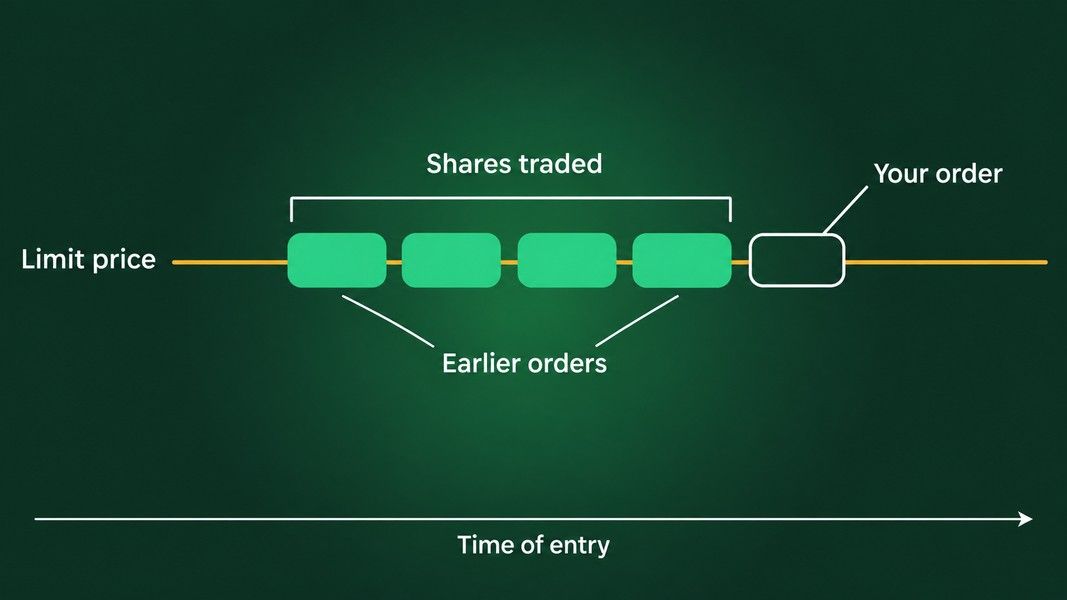
So a low of exactly $50.00 means someone bought at $50.00. It does not mean everyone did. If you need to own the stock, a limit at the low you expect is the wrong tool; if you only want that price, an unfilled order is the order doing its job.
Only part of it filled
A partial fill executes some of your shares and leaves the rest open. A 500-share buy at $50.10 may meet only 200 shares offered at that price before the market moves away, and the other 300 keep waiting.
Schwab points out a cost that is easy to miss: where commissions apply, an order filled across several days can carry a commission for each day on which part of it executes. All or none and fill or kill exist to avoid fills in pieces, and both make any fill less likely.
The order expired
A day order that did not fill is gone at the close, and a GTC order lapses at the broker's limit. If you meant to keep waiting at that price, the order has to be placed again.
The market moved away and never came back
The simplest reason of all. You set a buy limit at $48 on a stock trading at $50, and it went to $55 instead. This is the trade-off FINRA describes, working exactly as written.
When a Limit Order Fills at a Better Price
A limit is a worst acceptable price, not a target. If a stock closes at $50 and opens at $46 after bad news, a resting GTC buy limit at $48 can fill below $48, because a buy limit executes at the limit or lower. A sell limit at $55 works the same way in reverse when a stock opens at $58.
That looks like luck, and often it is not. The order filled because the stock went through your price, and whatever pushed it there is still true after you own the shares. A resting order set weeks ago carries what you knew weeks ago.
The same gap problem hits stop orders from the other side. A stop-limit becomes a limit order once triggered, and a price that gaps past its limit can leave it unfilled, which our stop-loss guide walks through with a real open.
Choosing the Price With a Second Read of the Chart
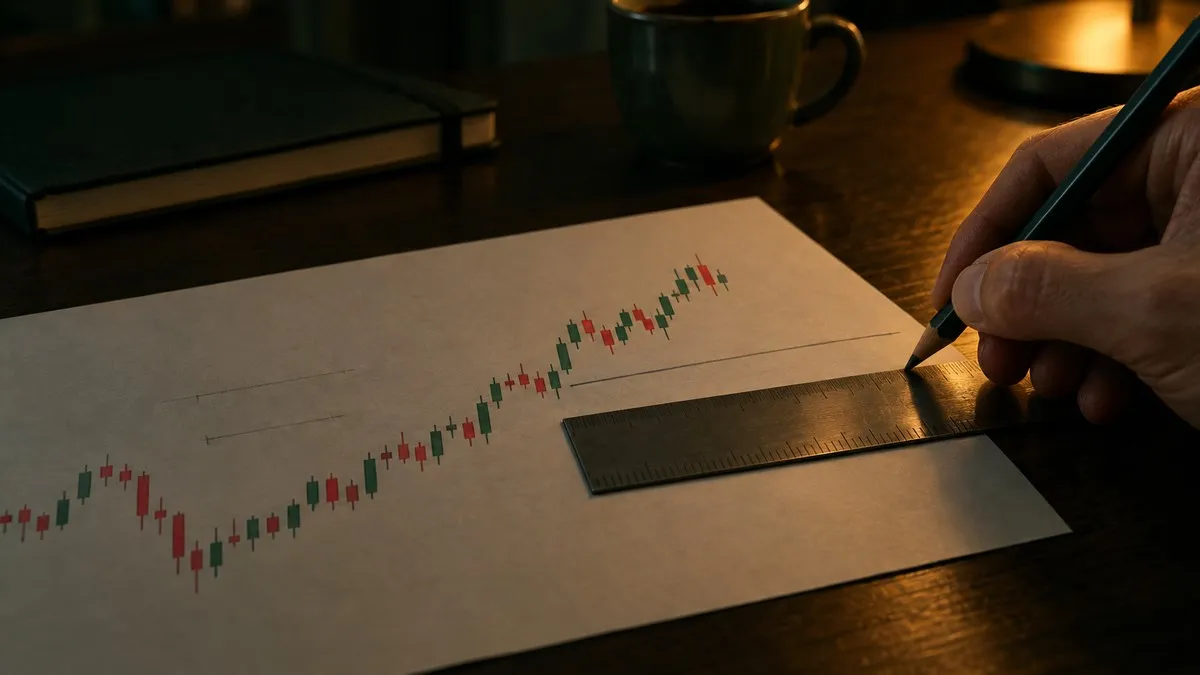
Most limit prices come from a chart: a recent low, a level the stock has turned at before, the edge of a pattern. That read is where a second opinion can help, while the order itself stays your decision.
Primo Trade gives an AI analysis from a photo or screenshot of a chart: the AI's read of trend, volatility, volume and sentiment, and the chart pattern it sees with what that pattern usually signals. Every result carries a signal as the AI's read, a Primo Score and a Trading Strategy with a risk level and two or three action points written as text, and a ticker analysis adds a price chart and recent news.
Primo Trade does not place orders, connect to a broker or set a limit price for you. It is a second read of the same chart you are looking at, for research before you decide.
Primo Trade gives AI-generated analysis for information and education. It is not financial advice. Markets carry risk; do your own research before you trade.
What a Limit Order Will Not Do
A limit order controls one thing, the price of a fill. It does not tell you whether that price is a sensible one, it does not protect a position after you hold it, and it does not decide your exit, which is a separate order with its own trade-offs.
It also does not guard against your own old instructions. An open GTC order is a decision you made once and keep making every day until it fills, expires or you cancel it.
Limit Orders in Short
A limit order buys at your price or lower, or sells at your price or higher, and may not fill at all. Set it in this order: side and quantity, a look at the bid, ask and spread, a price chosen on purpose in whole cents, a time in force, and the session.
When it does not fill, the usual reasons are the queue at your price, a partial fill, an expired order or a market that moved away. When it fills better than your limit, ask why the price got there before treating it as a bargain. A day order ends at the close, and a GTC order at Fidelity or Schwab lasts up to 180 days, so review what you have left open.