It is 4:07 p.m. A company you own just released earnings, and the stock on your phone is down 9% while the market is supposedly closed. You can still sell. The question is whether you should do it the way you would at 11 a.m.
After-hours trading is the buying and selling of US-listed stocks after the regular session closes at 4 p.m. Eastern Time, usually until 8 p.m. Orders match on electronic venues with far fewer buyers and sellers than during the day, so spreads are wider, prices jump more, and most brokers accept only limit orders. This guide covers the after-hours trading hours, why the price you see can mislead you, and how to place an order step by step.
After-Hours Trading Hours, Session by Session
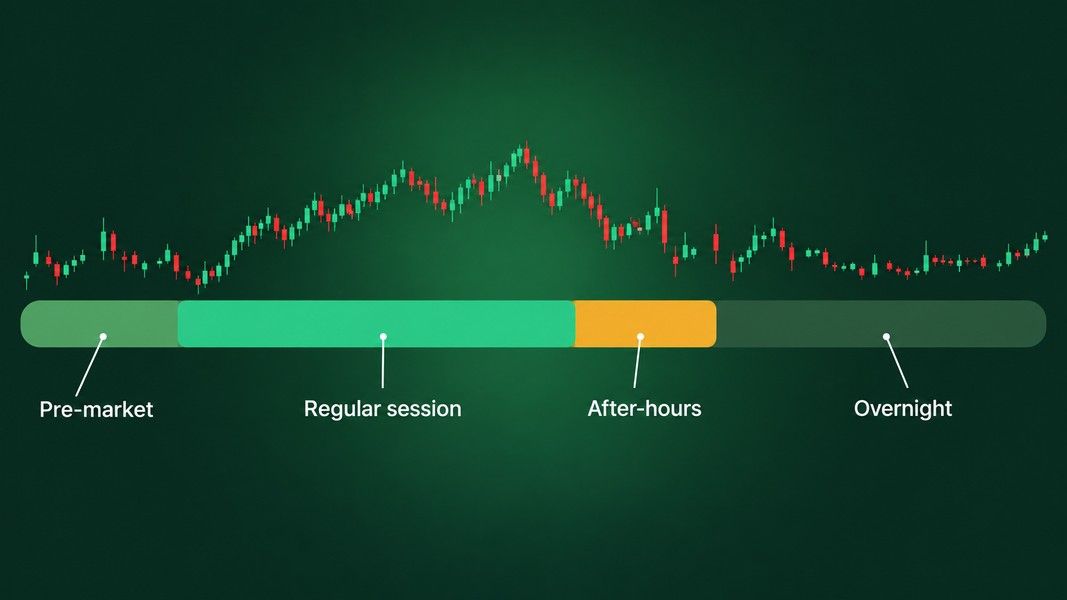
The regular session runs from 9:30 a.m. to 4 p.m. ET. Everything outside it is "extended hours", and the edges depend on who you ask.
FINRA's investor page on extended-hours trading describes pre-market trading as typically 7 to 9:30 a.m. ET and after-hours trading as 4 to 8 p.m. ET, and notes that overnight trading between 8 p.m. and 4 a.m. is now open to retail investors for certain stocks. Nasdaq itself already runs a pre-market session from 4 a.m., so the morning window at your broker may start anywhere between 4 and 8 a.m.
| Session | Typical hours (ET) | What it is like |
|---|---|---|
| Pre-market | 4:00 or 7:00 to 9:30 a.m. | Reacts to overnight news and earnings released before the open |
| Regular | 9:30 a.m. to 4:00 p.m. | Deepest liquidity, consolidated best prices, every order type |
| After-hours | 4:00 to 8:00 p.m. | Earnings and news releases, thin books, mostly limit orders |
| Overnight | 8:00 or 9:00 p.m. to 4:00 a.m. | Selected stocks through alternative venues, very thin |
These hours are not a sideshow anymore. NYSE research on off-hours trading found that as of January 2025 extended-hours trading accounted for over 11% of all US equity trading, more than 1.7 billion shares a day, up from just over 5% in the first quarter of 2019.
Why Trading After Hours Feels Different
That share is spread over many hours and thousands of stocks, so many names trade thinly after the close. A large stock on earnings night can be busy. A small one can go minutes without a print.
FINRA Rule 2265 requires every broker that offers extended hours to hand you a risk disclosure statement, and its model text is a useful checklist of what changes after 4 p.m.:
- Lower liquidity. Fewer orders on the book, so your order may fill only partly, or not at all.
- Higher volatility. Prices swing further between trades.
- Changing prices. The after-hours price may not match the close or the next morning's open.
- Unlinked markets. Different venues can show different prices for the same stock at the same moment.
- News announcements. Companies usually release market-moving news outside regular hours.
- Wider spreads. The gap between the bid and the ask grows, which is a cost you pay on entry and exit.
The unlinked-markets point is the one most people miss. During regular hours, brokers generally have to fill your order at the national best bid or offer. FINRA explains that this best price is published only during regular hours, so the requirement does not apply after the close. Your order may fill on one venue while a better price sits on another one your broker does not reach.
FINRA adds two more limits worth knowing: stock options generally do not trade in extended hours, and some brokers do not offer extended-hours trading at all.
What You'll Need Before Your First Order
Before you try to buy or sell after 4 p.m., have four things lined up:
- A brokerage account with extended-hours trading switched on, and the risk disclosure your broker made you accept.
- Your broker's exact session times and which stocks it allows outside regular hours.
- A live quote showing the bid, the ask and their sizes, not only the last trade.
- A price you are willing to trade at, decided before you open the order ticket.
How to Place an After-Hours Order, Step by Step
Brokers label these screens differently, but the sequence is the same almost everywhere.
1. Confirm the session your broker supports
Check whether your broker covers after-hours only, pre-market too, or an overnight session, and for which symbols. Some stocks do not trade at all outside regular hours, and some brokers only show quotes from the single venue they route to.
2. Choose an extended-hours time in force
Your broker decides whether an ordinary day order keeps working after the close, and the SEC suggests checking whether an order placed during regular hours carries over into after-hours trading. Where it does not, look on the order ticket for a time-in-force setting that covers extended hours, often labelled "extended" or similar.
3. Read the bid, the ask and the spread
The last trade price after hours can be minutes old. Look at what buyers are bidding and sellers are asking right now. If a stock that trades a cent wide at noon shows a dollar between bid and ask at 5 p.m., that dollar is part of your cost.
4. Use a limit order and set the price yourself
FINRA notes that brokers might only accept limit orders during extended hours. That is a protection, not a nuisance. A limit order fills at your price or better, and if the market moves away from it, it does not fill. After hours, a limit order is the only thing standing between you and whatever price the thin book happens to offer.
5. Size the order for a partial fill
Thin books fill in pieces. If you send 500 shares and there are 120 on the bid at your price, you may get 120 and wait for the rest. Decide in advance whether a partial fill is acceptable, or start smaller.
6. Decide what happens if it does not fill
Brokers differ on whether an unfilled extended-hours order is cancelled at the end of the session or carried into the next one. Find out which before you leave the order working overnight, so you do not wake up to a fill you had forgotten about.
A Worked Example: Earnings at 4:05 p.m.
This one is invented, with round numbers to make the mechanics clear.
A stock closes at $80. At 4:05 p.m. the company reports earnings and cuts its guidance. Within minutes the after-hours quote shows a bid of $70.10 for 300 shares and an ask of $71.40. The spread that was a few cents during the day is now $1.30.
Maya owns 500 shares and wants out. She enters a limit sell at $70 with an extended-hours time in force. 300 shares fill at $70.10 straight away. The remaining 200 sit on the book until another buyer shows up at 4:41 p.m., also around $70.
Leo owns the same stock and thinks the drop is overdone. He places a limit sell at $74, hoping for a bounce. Nothing trades that high, and his order expires at 8 p.m.
The next morning the stock opens at $72. Maya sold below that open, and Leo still holds a stock that sits $8 below the close. Neither outcome was knowable at 4:07 p.m. The point is mechanical: the after-hours price was not the next day's price, which is exactly the "changing prices" risk in FINRA's disclosure.
The same gap can hit a stop order placed during the day. If you want to see why a stop can fill far below its price on a gap like this one, read how stop orders behave when the open jumps past them.
Troubleshooting Common After-Hours Problems
Your order shows "open" but never fills. The market moved away from your limit, or nobody is trading that stock right now. Check the bid and ask sizes. If there is no one on the other side at your price, nothing happens until there is.
You got part of the order. That is normal in a thin book. Either leave the rest working, change the limit, or cancel the remainder.
The order was rejected. Typical causes are a market order the session does not accept, a day time in force on an order sent after 4 p.m., or a stock your broker does not offer outside regular hours.
The venue itself stopped. This is rare but real. On August 5, 2024, Blue Ocean, an alternative trading system that several brokers used for overnight orders, cancelled trades executed between 1:45 and 3:06 a.m. ET after a spike in volume and halted trading. Robinhood suspended its overnight session that night and routed open orders for execution from about 4 a.m. Overnight trades that you thought were done were undone.
Overnight and 23-Hour Trading: What Changes in December
The edges of the trading day are moving. On April 10, 2026, the SEC approved Nasdaq's plan for trading 23 hours a day, five days a week. A law firm memo on the Nasdaq approval lays out the structure: a Day Session from 4 a.m. to 8 p.m. ET, a one-hour pause for maintenance and corporate actions, and a Night Session from 9 p.m. to 4 a.m., with the trading week starting Sunday at 9 p.m. The same memo notes that the Night Session will offer more limited functionality and order types, much like today's pre-market and after-hours sessions, and that the SEC approved NYSE Arca's similar plan for 22-hour trading in February 2025.
Nasdaq has said it plans to launch the overnight session on Sunday, December 6, 2026, and NYSE Arca is also targeting late 2026. NYSE's own page shows the planned Arca schedule as Overnight 9 p.m. to 4 a.m., Early 4 to 9:30 a.m., Core 9:30 a.m. to 4 p.m. and Late 4 to 8 p.m., and notes that the consolidated data feeds have proposed extended hours too, subject to SEC approval.
What this changes for you: more hours in which a quote exists. What it does not change: a book at 2 a.m. will be thinner than one at 2 p.m., and every risk in the disclosure above still applies, just across more of the day.
Reading an After-Hours Move the Next Morning
A big after-hours move is information, but noisy information. A few habits help you read it without overreacting:
- Look at volume, not just price. A 9% move on a few thousand shares says less than the same move on millions.
- Find the news behind it. An earnings release, a guidance cut or a filing explains more than the candle does.
- Wait for the regular session to see where the deeper market prices it. FINRA notes that trading can become smoother once investors have had time to absorb the results.
If you want a second read once the dust settles, a ticker analysis in Primo Trade lists Recent News with dates next to the AI's read of prices and financial metrics, so the headline behind the move sits beside the numbers. You can also photograph a chart with Primo Trade's Analyze Chart and get the AI's read of the trend, volatility, volume and the chart pattern it sees.
Primo Trade gives AI-generated analysis for information and education. It is not financial advice. Markets carry risk; do your own research before you trade.
For how an overnight hold changes your risk compared with closing out every day, see swing trading versus day trading.
The Short Version
After-hours trading runs mainly from 4 to 8 p.m. ET, with pre-market sessions from as early as 4 a.m. and a growing overnight window. The stock is the same, the market around it is not: fewer orders, wider spreads, unlinked venues and no consolidated best price to protect your fill.
Placing an order comes down to six checks: your broker's sessions, an extended-hours time in force, a real look at the bid and ask, a limit price you chose in advance, a plan for a partial fill, and knowing whether an unfilled order dies at 8 p.m. or carries over. When 23-hour trading arrives in December, the same rules simply stretch across more of the clock.