

On October 31, 2024, Apple reported earnings per share of $0.97 for its September quarter, down from $1.46 a year earlier. A third lower, in a record September quarter for revenue. Two sentences further down the same release, Apple said earnings per share was $1.64, up 12 percent.
Both numbers were true. That is the whole problem with earnings per share, and also the reason it is worth learning properly.
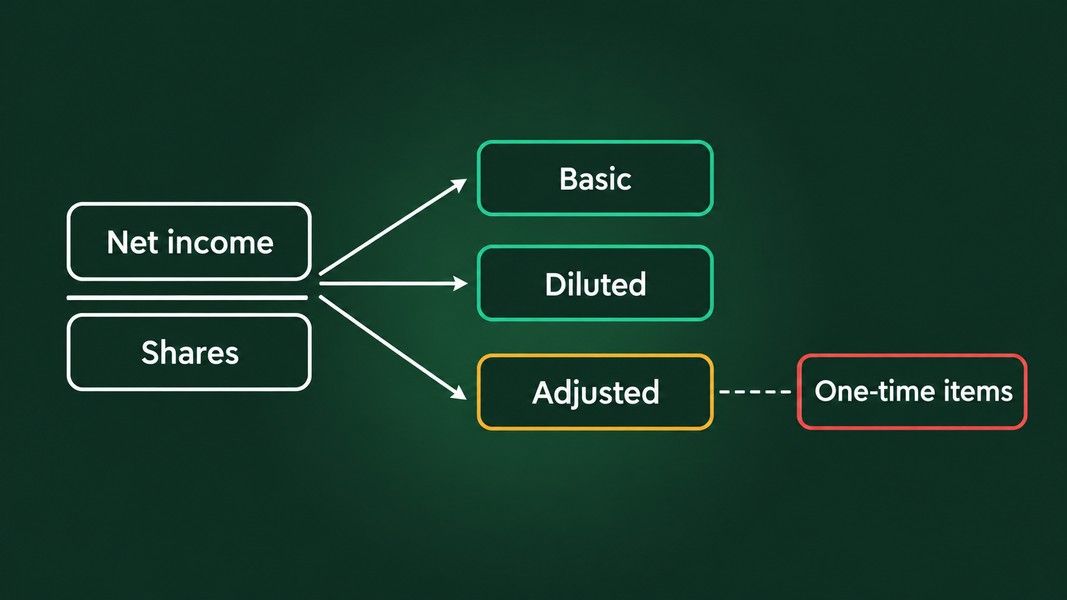
Earnings per share (EPS) is a company's net income divided by the number of its common shares, which makes it the slice of the quarter's earnings that belongs to one share. The formula is simple. The trouble is that every earnings release can carry at least three versions of it, and the headline you read may not be the one that matters for your question.
What earnings per share actually measures
The SEC's Investor.gov glossary keeps it to one line: a public company's net income divided by the number of its common shares. That is the idea. The working version has two refinements.
First, preferred dividends come off the top, because that money belongs to preferred holders and never reaches a common share. Second, the share count is a weighted average across the period, not the count on the last day. A company that bought back a lot of stock in the final week of the quarter only gets a sliver of credit for it in that quarter's EPS.
So the full earnings per share formula reads:
EPS = (net income - preferred dividends) / weighted average common shares outstanding
Why per share at all? Because net income on its own ignores how many pieces the company is cut into. A company earning USD 10 billion with 20 billion shares has less behind each share than one earning USD 5 billion with 5 billion shares. EPS puts both on the same footing, and it is the denominator in the P/E ratio, which is why it travels into almost every valuation you will read.
The earnings per share formula on a real quarter
Here is the formula worked on Apple's fiscal fourth quarter of 2024, the quarter ended September 28, 2024, using the figures in its quarterly results release. Apple has no preferred stock, so nothing comes off the top.
| Line | Q4 fiscal 2024 | Q4 fiscal 2023 |
|---|---|---|
| Net income | USD 14,736 million | USD 22,956 million |
| Basic shares (weighted average) | 15,171,990 thousand | 15,599,434 thousand |
| Diluted shares (weighted average) | 15,242,853 thousand | 15,672,400 thousand |
| Basic EPS | 0.97 | 1.47 |
| Diluted EPS | 0.97 | 1.46 |
| EPS excluding the one-time charge | 1.64 | not applicable |
Divide 14,736 million by 15.17 billion shares and you get about 0.971, which rounds to the reported basic EPS of $0.97. Divide the same net income by the larger diluted count and you get about 0.967, still $0.97 after rounding.
That is the arithmetic. The three versions it produces are where reading starts.
Basic vs diluted EPS: the shares that do not exist yet
Basic EPS divides by the shares that exist. Diluted EPS also counts the shares that could exist: stock options employees could exercise, restricted stock units waiting to vest, convertible bonds that could turn into stock. Companies estimate the extra shares with the treasury stock method, which assumes option proceeds are used to buy back stock, so only the net new shares are added.
Diluted EPS is never higher than basic. When a company loses money, the potential shares are left out, because adding them would make the loss per share look smaller.
For Apple the gap is small. Over the full fiscal 2024 year, basic EPS was $6.11 and diluted EPS was $6.08. A company that pays heavily in stock, or has convertible debt outstanding, can show a much wider gap, and that gap is real: those shares will claim a slice of future earnings.
When you compare companies or quarters, use diluted EPS. It is the more conservative number, and it is the one that already accounts for the stock the company has promised away.
Adjusted EPS: the company's own edit
Now the $1.64. Apple took a one-time income tax charge of USD 10.2 billion in that quarter, after the European Union's top court reversed an earlier ruling in the State Aid case over Apple's taxes in Ireland. Spread across about 15.24 billion diluted shares, that is roughly 67 cents a share, which is exactly the gap between $0.97 and $1.64.
The $1.64 is adjusted EPS, also called non-GAAP EPS. GAAP is the accounting rulebook every US-listed company has to follow; anything "adjusted" is the company's own version with certain items removed or added back.
There are rules around this. The SEC staff guidance requires a company that presents a non-GAAP measure to show the most directly comparable GAAP measure with equal or greater prominence, and to reconcile the two. It names the habit it wants to stop: leading an earnings release headline with the adjusted figure and leaving the GAAP one out. Non-GAAP per share measures have to be reconciled to GAAP EPS.
That is why Apple's release gave $0.97 first and $1.64 second, with a footnote pointing to the reconciliation table at the end.
Is adjusted EPS honest or flattering?
It can be either, and the reconciliation table is where you find out which. Ask one question of every line on it: does the excluded item come back?
Apple's tax charge settled a case about the past and is not going to repeat each quarter. Removing it gives a fair view of how the business ran that quarter. That is adjusted EPS doing its job.
Compare a company that excludes stock-based compensation every single quarter. Paying employees in stock is a cost that recurs as reliably as salaries, and those shares end up in the diluted count. A company that also excludes "restructuring" in most years has made restructuring part of how it runs, whatever the label says.
The same release can carry both kinds of adjustment. Read the table, not the headline.
When GAAP EPS is the misleading one
It is tempting to conclude that GAAP is the honest number and adjusted is spin. The second quarter of 2026 shows why that is too simple.
According to FactSet's earnings update of August 7, 2026, Alphabet reported GAAP EPS of $9.11 for that quarter against an analyst estimate of $2.88. The GAAP figure included a gain of USD 98 billion in other income, mainly unrealized gains on equity securities it holds. The business did not triple its earning power in three months; the value of investments on its books went up, and accounting rules ran that through net income.
FactSet noted that this one company, together with a similar gain at Amazon.com, pushed the whole S&P 500's aggregate earnings surprise to 29.2 percent for the quarter. Without the two, it would have been 10.9 percent.
The lesson runs both ways. A one-time charge can make GAAP EPS look terrible, as with Apple. A one-time gain can make it look spectacular, as with Alphabet. Neither number reads itself; you have to find the large, unusual line behind it.
How EPS grows while net income shrinks
There is a third way EPS can move that has nothing to do with how the business performed: the share count.
Take Apple's full fiscal 2024 year against fiscal 2023, again from the same release. Net income fell from USD 96,995 million to USD 93,736 million, down about 3.4 percent. Diluted EPS fell from $6.13 to $6.08, down less than 1 percent. The difference is the denominator: the diluted share count dropped from about 15.81 billion to 15.41 billion, roughly 2.6 percent fewer shares.
Nothing about that is hidden or improper. Fewer shares really do mean each remaining one owns more of the company. But it does mean EPS growth and earnings growth are two different things, and a company can report rising EPS on flat or falling net income for years if it keeps buying back stock. When EPS is rising, check whether net income is rising with it.
Beat or miss: EPS against an estimate
Most EPS headlines are not about the number at all. They are about the number against what analysts expected: a beat or a miss.
Beats are the normal outcome. In the same August 2026 update, FactSet counted 86 percent of reporting S&P 500 companies with EPS above estimates for the second quarter, against a 5-year average of 78 percent and a 10-year average of 76 percent. When three out of four companies beat in an ordinary quarter, a beat on its own tells you little. What moves a stock after the report is usually the size of the beat against the estimate, the guidance for the next quarter, and whatever else the release revealed.
That reaction often happens outside regular hours, because many companies report after the closing bell. If you have ever watched a stock jump or drop sharply at 4:15 in the afternoon, that is after-hours trading reacting to an EPS line before most people have read the release.
Reading an EPS number in four checks
When an earnings release lands, these four checks take a few minutes and catch most of the traps above:
- Start with GAAP diluted EPS. It is the figure SEC rules say must be shown with at least equal prominence, and the one the other versions are reconciled to.
- Read the reconciliation table. For each adjustment, ask whether it will come back next quarter. One-off items can fairly be set aside; recurring costs cannot.
- Compare EPS growth with net income growth. If EPS is rising much faster, the share count is doing part of the work.
- Compare with the same quarter last year. Many businesses are seasonal, so quarter against previous quarter can mislead.
EPS also says nothing about how the earnings were financed. A company can lift EPS by borrowing to buy back stock, which is why it is worth reading alongside the debt to equity ratio.
Where a second read fits
If you would like a second read before going through the filings, Primo Trade runs an AI analysis on a US-listed stock from its ticker, pulling prices, recent news and financial metrics together. The result includes a Fundamental score from 0 to 100 inside the Primo Score, and Key Insights tagged fundamental where the AI found something worth noting. A score of 80 is the AI's read of the data, not an 80 percent chance of anything. Primo Trade gives AI-generated analysis for information and education. It is not financial advice. Markets carry risk; do your own research before you trade.
The short version
Earnings per share is net income divided by the weighted average share count, and almost every quarter comes with at least three versions of it. Basic counts the shares that exist; diluted adds the shares that could; adjusted is the company's own edit with certain items removed.
Diluted GAAP EPS is the anchor. Adjusted EPS is useful when the items it removes truly do not repeat, as with Apple's one-time tax charge, and flattering when they do. GAAP itself can mislead when a one-time gain flows through, as Alphabet's investment gains did in 2026.
Behind any EPS number, look for the big unusual line, the change in share count and the comparison with a year earlier. The number on the headline is where reading starts, not where it ends.