You buy a stock at $50 and set a stop at $47. You go to bed feeling responsible. Overnight the company warns on its earnings, and in the morning your broker tells you the shares sold at $41.
Nothing broke. The order did exactly what it was built to do. It just was not built to do what you thought.
A stop-loss is an order to sell a stock automatically if its price falls to a level you pick in advance. The level is a trigger, not a price you are promised. That one distinction explains most stop-loss surprises, and it is where the stop-limit and the trailing stop come in.
Meta's open on February 3, 2022 shows how far apart the trigger and the price can get.
How a Stop-Loss Order Works
The SEC's investor bulletin calls it a stop order, also known as a stop-loss order: an order to buy or sell once the stock reaches a price you set, the stop price. When the stop price is reached, the order becomes a market order.
A sell stop sits below today's price on a stock you own, to cap a loss or to protect a position that has already risen. A buy stop sits above today's price and does the same job for a short seller, who loses money when the price rises.
The words that matter are "market order". A market order is built to fill, not to fill at a particular price. As Investor.gov puts it, the last traded price is not necessarily the price at which a market order will execute.
Brokers also differ on what counts as reaching the stop. The SEC notes that some use the last traded price and others use quotes. FINRA's rule for stop orders says a stop order is triggered by a trade at the stop price, and an order a broker triggers some other way has to carry a different name. So check what your broker means by "stop" before you rely on one.
The Stop Price Is a Trigger, Not a Promise
FINRA, the self-regulatory body for US brokers, put out guidance on this in May 2016. Regulatory Notice 16-19 leads its list of warnings with exactly this point: the stop price is not the execution price. A triggered stop is a market order, firms have to fill it promptly at the current market price, and in a fast market that price "may be very different" from the stop.
Three situations make the difference bigger:
- Fast markets. The Investor.gov glossary warns that the fill can differ from the stop price, especially when prices change rapidly.
- Gaps. If bad news lands overnight and a stock opens well below your stop, the stop is triggered at the open and sells at what buyers are paying then. The SEC's point is that a triggered stop fills at the prices of the liquidity available, not at the number you typed.
- Brief dips. A short, sharp drop during the day can trigger a stop, and the SEC notes the sale can come out substantially worse than that day's closing price. FINRA adds that the stock may go back to its earlier level the same day, after you have sold.
FINRA's notice has one more uncomfortable line: in extreme volatility, sell stops being triggered can add downward pressure on the price, and a stop triggered in a steep decline is more likely to fill well below its price.
Stop vs Stop-Limit Orders on the Same Gap
Picture a stock that closes at $50. Two people own it and protect it differently.
Ana places a sell stop at $47. Ben places a sell stop-limit order with a stop price of $47 and a limit of $46: once $47 trades, his order becomes a limit order to sell at $46 or better, never worse.
Overnight, bad news. The stock opens at $41 and drifts lower all day.
Ana's stop triggers at the open, becomes a market order and sells close to $41. She is out, $6 a share below plan, but she is out.
Ben's order triggers too and becomes a limit order at $46. Nobody pays $46 for a stock trading at $41, so the order just sits there. Ben still owns every share, and they keep falling.
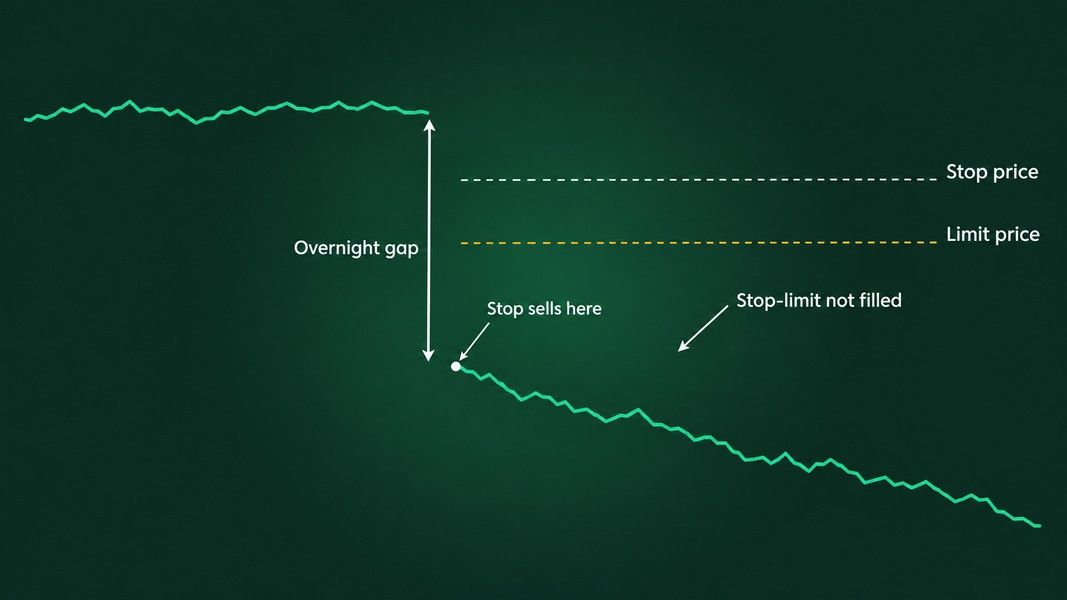
This is the trade-off FINRA describes. A stop buys you an exit at a price you did not choose; a stop-limit buys you a price, with the risk of no exit at all. FINRA's words for the stop-limit are "additional certainty" on price and "the possibility that the order will not be executed at all". It even suggested brokers consider making the stop-limit the default, so a plain stop becomes a deliberate choice.
The SEC's own example uses small numbers: a sell stop-limit with a stop price of $3.00 and a limit of $2.50 becomes an active limit order when $3.00 trades, and can only sell at $2.50 or better. If the price falls straight through $2.50, nothing sells.
Stop, Stop-Limit and Trailing Stop Side by Side
| Stop (stop-loss) | Stop-limit | Trailing stop | |
|---|---|---|---|
| When triggered, it becomes | A market order | A limit order | A market order, or a limit order if set up as a trailing stop-limit |
| What you can count on | A sale, at whatever price is there | A price at your limit or better | A stop that rises as the price rises |
| What you give up | Control of the price | Certainty of a sale | Room: a normal pullback can set it off |
| When the stock gaps past it | Sells at the lower price | May not sell at all | Behaves like the stop or stop-limit it is |
A Real Gap: Meta on February 3, 2022
Here is the same thing on a real stock, read after the fact: a past event that shows how orders behave, not a view on the stock.
Meta Platforms, then still trading as FB, reported fourth-quarter results after the close on Wednesday, February 2, 2022. It had closed that day at $323, according to Business Insider. At 9:34 a.m. Eastern the next morning it was at $240.31.
Yahoo Finance's daily price history for February 3 shows an open of $244.65 and a high of $248.00. By the close it had fallen $85.24, or 26%, to $237.76, as CBS News reported, the biggest one-day loss of market value for a public company on record at the time.
Now imagine two holders going into that night.
The first had a sell stop at $300, about 7% under Wednesday's close. The stock opened far below $300, so the stop would have triggered at the open and sold at or near $244.65, about $55 a share below the stop.
The second had a stop-limit, stop $300 and limit $295. It triggered at the open too and became a limit order to sell at $295 or better. The stock never traded above $248 that day, so the order never filled.
A chart read on Wednesday afternoon could not have known this: the price that mattered came from a release published while the market was shut. No stop placement on a chart protects against a price that never trades through it.
Trailing Stop Loss: A Stop That Follows the Price Up
A trailing stop is a stop or stop-limit order whose stop price is not a fixed number. It is a dollar amount or a percentage below the market price, and it moves up as the price rises. When the price falls, it stays put.
The SEC's own example in the same bulletin runs like this. You buy a stock at $20. It rises to $22, and you set a sell trailing stop $1 below the market price. The stock climbs to $24, so the stop climbs to $23. The price then turns down, the stop stays at $23, and when $23 trades the shares are sold, though the SEC notes the sale price may differ from $23.
That is the appeal: the floor rises with the stock and you never have to move it by hand. The cost is choosing the distance. Set the trail tight and an ordinary wobble sells you out; the SEC warns that short-term fluctuations can trigger a trailing stop. Set it wide and you give back more of the rise before it fires.
And on a gap, a trailing stop is just a stop. Had one been trailing Meta at $300 that February night, it would have met the same open as everyone else.
When a Blip Sets It Off: August 24, 2015
Gaps are one problem. The other is the drop that comes and goes before you have finished your coffee.
On Monday, August 24, 2015, the most actively traded US equity product, the SPDR S&P 500 ETF Trust, opened sharply lower and by 9:35 a.m. was 7.8% below Friday's close. By 9:40 it had recovered past its opening price, and it closed the day down 4.2%. That is from the SEC staff's research note on the day.
Run a sell stop 6% under Friday's close through that morning. It triggers within the first five minutes, sells somewhere in the drop, and the fund closes the day above the price you got. That is the SEC's "substantially worse than the closing price" warning, played out in real time.
FINRA's notice suggested that brokers consider limiting stop triggers around the open and the close, when markets may be more volatile, and setting an expiry on good-til-cancelled stops, giving 90 days as an example. Your broker may do one, both or neither. It is worth finding out which.
Where Traders Set a Stop
There is no official rule. The common approaches:
- Below a level on the chart. Many traders put the stop just under a recent low or support line, so it is hit only if the chart's story breaks. Our guide to bullish and bearish chart patterns explains the levels traders watch, and the chart patterns cheat sheet draws them.
- A fixed percentage. Some simply use a set distance below the entry.
- By account risk. A widely repeated trading convention is to size each position so hitting the stop costs only a small, fixed slice of the account. It is a practitioner habit, not a regulatory or academic standard.
Whatever the method, the failure modes are the same. Too close, and normal movement takes you out. Too far, and the stop does not limit much.
If you want a second read of a chart's trend and pattern, Primo Trade can analyze a ticker or a chart photo, name the chart pattern its AI sees and suggest a strategy idea with a risk level. A risk level in Primo Trade's Trading Strategy section is the AI's read of the data, not an order. Nothing sells because an analysis said "high risk"; only an order at your broker does that.
Primo Trade gives AI-generated analysis for information and education. It is not financial advice. Markets carry risk; do your own research before you trade.
Our article on how AI reads a stock chart explains how to check its read, and our guide to reading candlestick charts covers the basics.
Do Stop-Loss Rules Actually Help?
The honest answer is "it depends on how prices behave", and there is real research behind that.
Kathryn Kaminski and Andrew Lo studied when stop-loss rules actually stop losses. They showed that if prices move like a random walk, simple stop-loss rules always lower a strategy's expected performance. When prices have momentum, meaning recent moves tend to continue, stop-loss rules can add value.
The 2007 working paper tested this on US stocks with monthly data from 1950 to 2004, with a strategy that moved into long-term government bonds whenever it was stopped out. Certain rules added 50 to 100 basis points per month during stop-out periods. That covers only the months spent in bonds, and it describes a whole basket of US stocks checked monthly, not a single-stock stop placed during the day.
The 2014 version in the Journal of Financial Markets used index futures with daily prices. There, certain stop-loss policies improved expected performance and cut volatility over longer intervals, which again says little about a stop that fires on one morning's dip.
So here is the limit, said plainly. A stop-loss is a risk control, not a source of performance. It caps what one decision can cost you when the price moves through it in an orderly way. It does nothing against a price that opens below it, and it can cost you when a stock dips, sells you out, and recovers by lunch.
How to Use a Stop-Loss
- Decide the stop before you buy. It is much harder to choose a sensible level once a trade is already losing.
- Pick the order type on purpose. A stop gets you out at an uncertain price; a stop-limit holds your price but may not get you out.
- Set the limit gap on purpose, too. On a stop-limit, the further the limit sits below the stop, the more room it has to fill and the worse the price it may accept.
- Leave room for normal movement. Look at how much the stock usually moves in a day before choosing the distance.
- Ask your broker four things. Which of the three order types it offers at all, since the SEC notes they are not available at every firm; what triggers a stop (trades or quotes); whether stops work outside regular hours; and when a good-til-cancelled stop expires.
- Know when gaps are likely. Results releases and other news outside market hours are when a price can jump straight past your stop.
- Do not move it down. Lowering a stop as the price approaches it turns a plan into a hope.
Conclusion
A stop-loss order sells a stock automatically once its price reaches a level you set in advance. A plain stop turns into a market order and can fill well below the stop price in a fast market or a gap; a stop-limit holds the price but may not sell at all; a trailing stop follows a rising price up and stays put when it falls.
Meta's open on February 3, 2022 and the first minutes of August 24, 2015 show the two ways a stop surprises people: a price that jumps past it, and a dip that takes it out before recovering. Research by Kaminski and Lo found stop-loss rules lower expected performance when prices move randomly and can help when prices have momentum. Treat a stop as a limit on what one decision can cost, set it before you enter, and know how your broker triggers and fills it.