
On August 2, 2024, Intel shares fell 26% to $21.48 in a single session. By the close, one share cost less than the accounting value of what that share owned. The price to book ratio, the share price divided by book value per share, had dropped to about 0.8, which a screener reads as "trading below book".
That phrase sounds like a bargain. This post reads the window after the fact, from Intel's August 1, 2024 earnings release to the deals of September 2025, using Intel's own filings: what the ratio said that Friday, what happened to the "book" half of it three months later, and what no balance sheet could have shown.
What the Price to Book Ratio Measures
Book value is what is left when you subtract everything a company owes from everything it owns. On a balance sheet it is called stockholders' equity. Divide it by the shares outstanding and you get book value per share; divide the share price by that and you get the price to book ratio, written P/B.
A P/B of 1 means the market prices the company at exactly its accounting net worth. Above 1, buyers are paying for something the balance sheet does not carry: future earnings, a brand, a technology lead. Below 1, the market is saying the books overstate what the assets are worth, or that the business will eat into them.
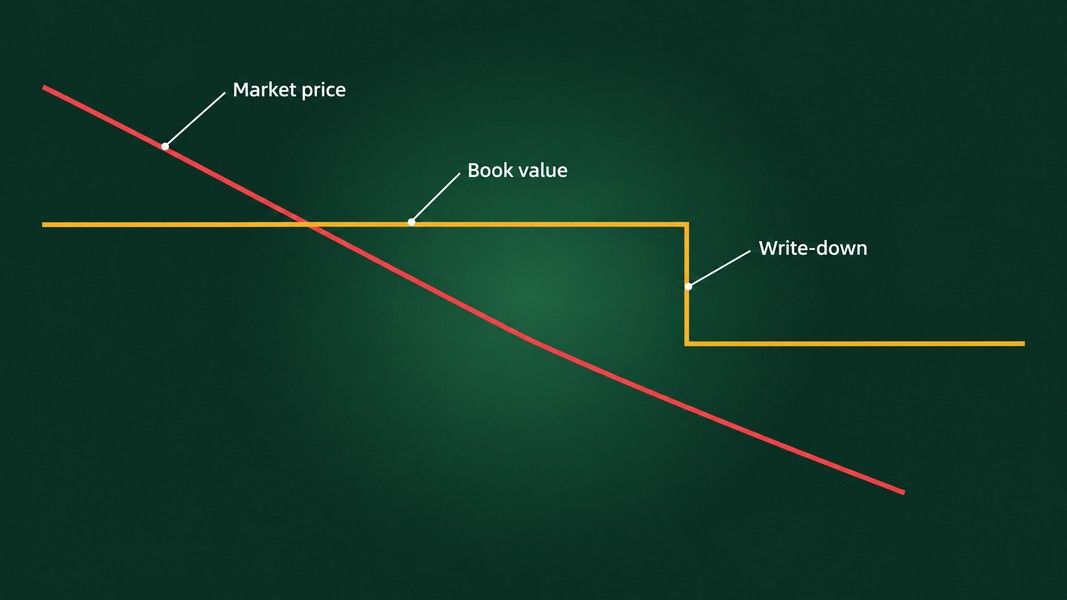
The ratio is only as reliable as its denominator, and the denominator is an accounting estimate, not a price. Factories sit on the books at cost minus depreciation. Goodwill sits at what was paid for an acquisition. Tax assets sit at what the company expects to use. Any of these can be marked down in a single quarter, and in Intel's case several were.
The formula in one line
P/B = share price ÷ (equity attributable to the company ÷ shares outstanding). The middle step matters. Many companies report a total equity figure that includes non-controlling interests, the slices of subsidiaries owned by outsiders, and those slices do not belong to the shareholders whose price you are dividing.
Intel's Book Value Before the Drop
The last balance sheet before the earnings release was dated June 29, 2024. Intel's next quarterly SEC filing for the following quarter restates it: total stockholders' equity of $120.4 billion, of which $5.2 billion belonged to non-controlling interests. That leaves $115.2 billion for Intel's own shareholders, spread over 4,276 million shares.
| Item | Value |
|---|---|
| Equity attributable to Intel, June 29, 2024 | $115.2 billion |
| Shares outstanding | 4,276 million |
| Book value per share | $26.95 |
| Close on August 2, 2024 | $21.48 |
| Price to book ratio | 0.80 |
Multiply the close by the share count and the market was valuing all of Intel at about $92 billion, roughly $23 billion less than its own books said the company was worth. The same equity figure is the denominator of the debt to equity ratio, so anything that shrinks it moves both ratios at once.
Why Intel Fell Below Book Value in One Day
The trigger was the second-quarter report, released after the close on August 1. Revenue was $12.8 billion, down 1% from a year earlier. The GAAP net loss attributable to Intel was $1.6 billion, or $0.38 a share, while the non-GAAP figure showed a profit of $0.02 a share; that gap between two versions of one quarter is the subject of our post on earnings per share.
The same release announced a $10 billion cost reduction plan, a headcount cut of more than 15%, and the suspension of the dividend from the fourth quarter. CEO Pat Gelsinger called the results "disappointing", and the CFO named "the impact from unused capacity" among the reasons margins fell, according to Intel's second-quarter release.
The next day the stock had its worst day since 1974, as Reuters put it, closing at a price CNBC noted had not been seen since 2013.
Price to Book Ratio Below 1: Two Readings at the Time
On the afternoon of August 2, a P/B of 0.80 supported two stories, and the number alone could not choose between them.
The first is the value reading. The factories, the patents and the cash on the books are worth more than the market is paying, the selloff is an overreaction, and the gap closes when sentiment turns.
The second is the trap reading. The assets are not worth what the books say, or the business will lose money using them until the equity is smaller than it looks. In that story the price is not below book value; the book value is above reality, and the filings have not caught up.
What separates the two is whether the assets earn. Intel's GAAP operating margin for the quarter was minus 15.3%, and its own CFO pointed at unused capacity. A company losing money on its assets tends to shrink its equity quarter by quarter, through losses, write-downs, or both. That does not prove the trap reading. It does mean the denominator of the ratio was under pressure on the day the ratio looked cheapest.
Three Months Later, the Book Shrank
On October 31, 2024, Intel reported its third quarter. Revenue was $13.3 billion. The net loss attributable to Intel was $16.6 billion, or $3.88 a share, and the third-quarter release listed what drove it:
- $9.9 billion of non-cash charges to set up a valuation allowance against US deferred tax assets
- $2.9 billion of goodwill and intangible asset impairments, mainly for the Mobileye reporting unit
- $3.1 billion of impairments and accelerated depreciation on manufacturing assets, mostly the Intel 7 process node
- $2.8 billion of restructuring charges, $2.2 billion of which will be paid in cash later
A deferred tax asset is the value of future tax savings, and it only counts if the company expects taxable profits to use it against. Intel wrote it down "due to a historical cumulative loss". In plain terms, part of the book value was a bet on future profits, and the accountants stopped counting it.
The same price against the new book
At September 28, 2024, equity attributable to Intel was $99.5 billion over 4,309 million shares.
| Measure | June 29, 2024 | Sept 28, 2024 |
|---|---|---|
| Equity attributable to Intel | $115.2 billion | $99.5 billion |
| Shares outstanding | 4,276 million | 4,309 million |
| Book value per share | $26.95 | $23.10 |
| P/B at the $21.48 close of Aug 2 | 0.80 | 0.93 |
Hold the price still and the discount to book fell from 20% to 7%, without the stock moving a cent. About $15.7 billion of equity attributable to Intel had gone. Most of the quarter's loss came from non-cash charges against value that exists on paper until it is tested: tax assets, goodwill, the carrying value of a process node the market wanted less of.
Tangible Book Value: The Stricter Test
Some readers skip that argument by using tangible book value: equity minus goodwill and identified intangible assets. Goodwill is the premium paid over the assets in past acquisitions, and it cannot be sold on its own.
At September 28, 2024, Intel carried $24.7 billion of goodwill and $4.0 billion of identified intangibles. Take them out and tangible book value was $70.9 billion, or $16.45 a share. Against the August 2 close of $21.48, that is a price to tangible book ratio of about 1.31.
Measured on what Intel could physically point to, the stock was never below book in this window. The "below book" headline depended on which book you used, and the one in the screener was the softest version.
What Followed: Events No Balance Sheet Showed
A year later the story moved for reasons that sat in no 2024 filing. On August 22, 2025, Intel announced that the US government would buy 433.3 million new shares at $20.47 each, a 9.9% stake funded by $5.7 billion of CHIPS Act grants not yet paid and $3.2 billion from the Secure Enclave program. Reuters put the price about $4 below that day's close of $24.80.
On September 18, 2025, Nvidia agreed to invest $5 billion in Intel at $23.28 a share, below the previous close of $24.90, and Reuters reported in December 2025 that the stake had been taken.
Two details are worth sitting with. The government's price of $20.47 was below the $21.48 close on the day Intel first fell below book. And the government deal created 433.3 million new shares, so the share count in the denominator grew; when new shares are sold below book value per share, each existing share's slice of the book gets thinner.
None of this was visible to a P/B reading in August 2024. The ratio said the market doubted the books. The next quarter showed the market was partly right about the books. What came after turned on policy and a partnership, which no ratio of price to equity measures.
How to Read a Low Price to Book Ratio in Your Own Research
A P/B under 1 is a question, not an answer. Intel's window suggests five checks before the ratio means anything:
- Use equity attributable to the company, not total equity with non-controlling interests.
- Look at what the book is made of: cash and factories, or goodwill, intangibles and deferred tax assets.
- Ask whether the assets earn, through the operating margin and any talk of unused capacity.
- Compare the ratio with the company's own history and its industry, not with 1.
- Read the next quarterly filing for write-downs before trusting the denominator.
When you run a ticker analysis in Primo Trade, the AI reads financial metrics alongside prices and recent news, and the Fundamental score inside the Primo Score is its 0 to 100 read of that side of the business. A score is a summary, not a book value calculation. It will not tell you that a quarter of the equity is goodwill, so the filing is still where that answer lives.
Primo Trade gives AI-generated analysis for information and education. It is not financial advice. Markets carry risk; do your own research before you trade.
A chart photo carries none of this. Analyze Chart reads the trend, volatility, volume and pattern in the image, and a balance sheet is not on a chart, unless the AI reads a US ticker off the picture and runs the full ticker analysis instead.
What Intel's Price to Book Ratio Taught
Intel's P/B fell to about 0.80 on August 2, 2024, when a 26% drop put the share price below $26.95 of book value per share. Within one quarter, $15.7 billion of write-downs and charges cut that book to $23.10 a share, and the same price looked far less cheap.
On tangible book, which strips out goodwill and intangibles, the stock never traded below book in this window at all. And the events that moved the stock a year later, a government stake and an Nvidia investment, were outside anything the ratio could measure.
The ratio is worth reading. The denominator is worth reading more closely, because in a business that is losing money on its assets, book value is the number most likely to change next.