

On June 3, 2021, AMC Entertainment told the market it might sell up to 11.55 million new shares. Within hours the stock fell to $37.66, then turned around when AMC said the sale was already done, and closed at $51.34, down 18% on the day, according to CNBC's report. That day sits in the middle of the window this case study reads, December 2020 to August 2023.
That is stock dilution in its loudest form: a company issues new shares, and every share that already existed owns a smaller slice of the business. Below is how AMC did it, at what prices, what it did to a 100-share stake, and what the filings showed while it was happening.
What Stock Dilution Means for the Shares You Already Own
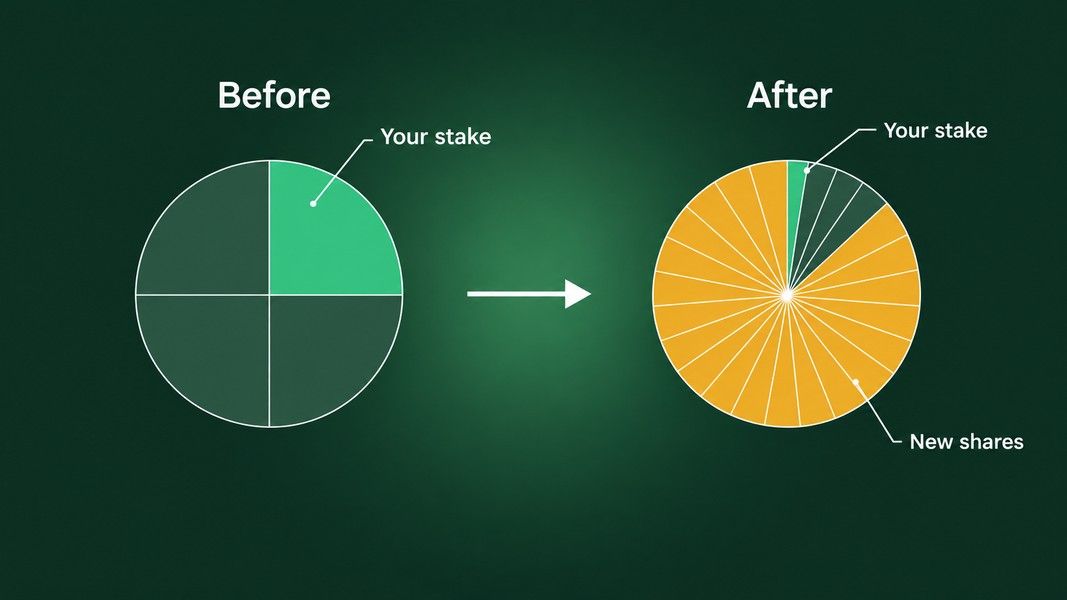
Think of a company as a pie cut into shares. If a company with 100 shares issues 100 more, your one share drops from 1% of the company to 0.5%, and you did nothing at all.
Your vote now counts for half as much. Each dollar of earnings is split across twice as many shares, which is why companies report a basic and a diluted figure, as our earnings per share explainer walks through.
Share dilution is not automatically bad. The new shares bring in cash, and if that cash keeps the company alive or buys something worth more than the slice given up, a smaller slice of a bigger pie can be worth having. The question is never only how many new shares, but what the company got for them.
AMC is a case where both sides of that question are written down, date by date, in its own SEC filings.
The Challenge: A Cinema Chain Running Out of Cash
By the end of 2020, AMC's theatres had spent most of a year closed or half empty. On January 21, 2021, it was operating 438 of its 593 US theatres, with limited seating and limited opening hours.
Cash and cash equivalents had fallen to about $308 million at December 31, 2020, from $417.9 million three months earlier, as the company reported in a January 2021 filing.
The same filing listed what AMC had done about it. Since its previous liquidity update on December 14, 2020, it had raised about $917 million. A large part came from selling stock: as of January 22, 2021, about 214.8 million new Class A shares sold through at-the-market programs for about $565 million before fees. That works out to roughly $2.63 a share.
There was a second source of new shares. In January 2021, holders of $600 million of convertible notes turned them into stock at $13.51 a share. That created 44,422,860 new shares and cut annual cash interest by $17.7 million, according to the company's quarterly report. Debt became equity: the balance sheet got lighter and the share count got heavier.
The Approach: Selling Shares Into the Rally
How an At-the-Market Offering Works
In a classic offering, banks take a block of new shares and sell it at one price on one day. An at-the-market offering is quieter. The company signs an equity distribution agreement with sales agents, who then sell new shares into the normal market "from time to time" at whatever the price happens to be.
For the company, the appeal is timing: it can sell more when the price is high and pause when it is low. For a holder, the catch is that the new supply arrives through the same order book they trade in, often during the very rallies that feel like good news.
AMC also filed a shelf registration on Form S-3 on April 27, 2021. A shelf registers shares ahead of time, so they can be sold quickly whenever the company chooses.
The Meme Rally Changed the Arithmetic
Then the retail buying wave arrived, the same one that carried GameStop, which our GameStop short squeeze breakdown takes apart. For AMC it meant each new share raised far more cash than it had a few months earlier.
| Sale | New shares | Gross proceeds | Per share, approx. |
|---|---|---|---|
| ATM sales reported as of Jan 22, 2021 | 214.8 million | $565 million | $2.63 |
| ATM agreement of Apr 27, 2021 | 43.0 million | $427.5 million | $9.94 |
| Private sale to Mudrick Capital, Jun 1, 2021 | 8.5 million | $230.5 million | $27.12 |
| ATM agreement of Jun 3, 2021 | 11.55 million | $587.4 million | $50.86 |
Shares and proceeds come from AMC's filings; the last column divides one by the other and ignores fees. Across 2021 as a whole, AMC's at-the-market programs sold 241.62 million shares for $1,611.8 million gross.
In January it took about 215 million new shares to raise $565 million; in June, 11.55 million new shares raised $587.4 million. The rally did not stop the dilution. It made each dollar of it cost far fewer shares.
June 2 and 3, 2021, on the Chart
The June 3 filing is worth reading for its risk language alone. AMC wrote that its stock had traded from an intra-day low of $1.91 on January 5, 2021 to an intra-day high of $72.62 on June 2, with a last sale of $62.55 that day.
It added that over the previous seven business days the stock had moved from $12.18 to $72.62, and that the company had "made no disclosure regarding a change to our underlying business during that period, other than with respect to an additional financing."
So the company told buyers, in writing, that nothing new about the business explained the price. Then it sold 11.55 million new shares at that price. On a daily chart the day shows up as one long candle: a plunge to $37.66, a recovery, and a close at $51.34. A chart reader saw the shape. The reason was in the 8-K.
When the Common Share Cap Ran Out: APE Units
A company can only issue as many common shares as its charter authorises. AMC's cap was 524,173,073 Class A shares, and by June 30, 2021, 513,330,240 were outstanding, about 98% of it. Raising the cap needed a shareholder vote.
In August 2022 AMC paid a special dividend in a new security, AMC Preferred Equity Units, one for each Class A share. Each APE was a 1/100th interest in a share of convertible preferred stock, designed to have the same economic and voting rights as a Class A share, according to the company's mid-2023 quarterly report. The units began trading on the NYSE on August 22, 2022, under the ticker APE.
The dividend itself diluted no one, because every holder got one unit per share. What followed did. Under an at-the-market agreement dated September 26, 2022, AMC sold 207.75 million APEs for $228.8 million, about $1.10 each.
By December 31, 2022, there were 516.8 million Class A shares and 724.6 million APEs. By June 30, 2023, there were 519.2 million shares and 995.4 million APEs.
The Results: AMC's Share Count From 2020 to 2023
| Date | Outstanding | What changed |
|---|---|---|
| Dec 31, 2020 | 172.6 million Class A, 51.8 million Class B | Before the January sales and note conversion |
| Jun 30, 2021 | 513.3 million Class A | Class B converted, ATM sales, notes converted |
| Dec 31, 2022 | 516.8 million Class A, 724.6 million APEs | APE dividend, then APE sales |
| Jun 30, 2023 | 519.2 million Class A, 995.4 million APEs | More APE sales |
| Aug 25, 2023 | 158.4 million Class A | 1-for-10 reverse split, APEs converted |
Counting each APE as the share it was designed to equal, the economic share count went from about 224.3 million at the end of 2020 to about 1.51 billion at mid-2023, roughly 6.8 times as many.
On August 24, 2023, AMC completed a 1-for-10 reverse split, and the next day every ten APEs converted into one new Class A share, 99,540,642 shares in all. A shareholder lawsuit settlement added 6,918,090 more, one share for every 7.5 held after the split. That left 158,377,971 Class A shares outstanding, following the schedule set out in the August 2023 filing.
What Happened to a 100-Share Stake
Take someone who held 100 AMC shares at the end of 2020 and never sold. They owned 100 of 224,333,033 shares, counting both classes.
In August 2022 they received 100 APEs. On August 24, 2023, their 100 shares became 10. The next day their 100 APEs became 10 more, and the settlement added 10 divided by 7.5, about 1.3 shares. That is roughly 21 shares out of 158,377,971.
Their slice of AMC was about 30% of what it had been in December 2020, so roughly 70% of their ownership had passed to new holders without them selling a thing.
The count kept rising after the window closed. AMC's 2025 annual report shows 512,943,561 shares at December 31, 2025, and says outstanding shares rose by 524,339,457 on a reverse-split adjusted basis from January 1, 2020 to February 18, 2026. Against that count, the same 21 shares are about 9% of the original slice.
What a Reading at the Time Could Not Have Known
Read only the share count and AMC looks like a disaster for holders. Read the cash and it looks like survival. Both are true.
In January 2021 nobody knew when theatres would fill again, or how long $308 million would last. The rally that made June's sale cheap in shares could not be forecast in December, and neither could the APE units that came a year later.
AMC put its own side plainly in the August 2023 filing: "Some of you fear dilution is a mistake no matter what. You are wrong. To the contrary, sometimes raising money is an absolute imperative." Whether the cash was worth the slice given up is a judgement each holder makes with their own numbers. The filings settle the count, not that question.
What a reader could know, at every step, was that dilution was coming. Each sale above was announced in an 8-K or a prospectus supplement, the cap on common shares was printed on every balance sheet, and AMC's annual report for 2020 already warned that "the dilution caused by recent and future sales of our Class A common stock could adversely affect the market price." The new supply was never hidden; it was just easy to ignore while the price was rising.
How to Spot Share Dilution Before It Hits the Chart
The same filings that told AMC's story exist for every US-listed company. Five places to look:
- Shares outstanding on the cover page. Every 10-Q and 10-K prints the count as of a recent date, so compare it with the same page a year earlier.
- Authorised against outstanding shares. The balance sheet lists both, and a company close to its cap may ask for a vote or reach for another security, as AMC did.
- Equity distribution agreements. An 8-K announcing one means an at-the-market program, and a prospectus supplement shows its size.
- Convertible notes and preferred stock. Securities that turn into shares later put new supply on a timetable.
- Cash against cash burn. A company with little cash and continuing losses has every reason to sell stock while the price is high.
What a Chart Read Can and Cannot Show
A chart shows the fade, not the filing behind it. Primo Trade's chart-photo read looks at trend, volatility, volume and the pattern it sees, and carries no news, so an offering is invisible to it.
A ticker analysis in Primo Trade is the other way in. It lists Recent News headlines with dates and links beside the AI's read, and its Key Insights are tagged technical, fundamental, news or sentiment, which is one place a share sale in the headlines can show up. The share count itself still lives on EDGAR, and checking it takes a few minutes.
Primo Trade gives AI-generated analysis for information and education. It is not financial advice. Markets carry risk; do your own research before you trade.
Key Takeaways
Stock dilution is a trade: a smaller slice for the existing holder in exchange for cash in the company. AMC made that trade again and again between December 2020 and August 2023, going from about 224 million shares to the equivalent of 1.5 billion, and a 100-share stake from December 2020 ended the window with about 30% of its old slice.
The rally changed the price of each new share, not the direction of the count. Every step was announced in a filing before or as it happened. A chart can show a sale landing, as it did on June 3, 2021, but only the cover page, the balance sheet and the 8-Ks say how many more shares are on the way.