
On Monday, August 2, 2021, anyone holding 100 shares of General Electric opened their broker and found 12. The price next to them had jumped from about 13 dollars to over 100. You had not traded anything, and the position was worth what it had been on Friday.
That was a reverse stock split: a company combines several existing shares into one, so the share count falls and the price per share rises by the same factor. GE combined every eight shares into one. This post reads that split after the fact, from the shareholder vote in May 2021 to the breakup that followed, and asks what a trader looking at it at the time could and could not have known.
What a reverse stock split does to your shares
The mechanics fit in one sentence. In a one-for-ten split, the SEC's investor education site explains, every ten shares you own become one, so 10,000 shares become 1,000.
The price moves the other way by the same ratio, so the value of your position does not change on the day. FINRA's own example uses a 200-to-1 split: 5,000 shares at 10 cents, worth 500 dollars, become 25 shares at 20 dollars, still worth 500 dollars.
A reverse split changes how the company is sliced, not how big it is. Here is what that looked like for a GE holder with 100 shares.
| Before (July 30, 2021) | After (August 2, 2021) | |
|---|---|---|
| Shares held | 100 | 12, plus cash for half a share |
| Reference price | 12.95 dollars | 103.60 dollars |
| GE shares outstanding | about 8.8 billion | about 1.1 billion |
| Quarterly dividend | 0.01 dollars per share | 0.08 dollars per share |
The half share is the part people forget. One hundred divided by eight is 12.5, and GE issued no fractional shares, so holders of record received a cash payment in lieu of them. The 103.60 dollar figure is the split-adjusted reference price Fox Business reported for that Monday morning, which is eight times a 12.95 dollar close.
Why GE needed one in 2021
Most reverse splits come from small companies whose stock has sunk toward a dollar. GE was a different case, and that is what makes it a useful one to study.
By 2021 GE had spent years selling businesses, including nearly all of GE Capital. The company got smaller, but the share count stayed where it was. GE's chief financial officer, Carolina Dybeck Happe, said so directly in the June 2021 announcement: the divestitures had come "without any corresponding adjustments to reduce our share count," and the split would "better align GE's number of shares outstanding with companies of our size and scope."
A 13 dollar share in a blue-chip company
That left a household-name industrial with roughly 8.8 billion shares trading in the low teens. A low price does not make a stock cheap in any meaningful sense, since the market value is the same whatever the slice. It does change how a stock looks on a screen and who notices it, which is why boards care about it at all.
The timeline, from vote to first trade
A reverse split is not a surprise on the day it happens. GE's ran over three months, and every step was public.
| Date | What happened |
|---|---|
| May 4, 2021 | Shareholders approve the split at the annual meeting |
| June 18, 2021 | GE confirms it will proceed, effective after the close on July 30 |
| July 30, 2021 | GE files the charter amendment; the split takes effect after the close |
| August 2, 2021 | GE trades on the NYSE on a split-adjusted basis, under a new CUSIP |
The July 30 filing adds two details most coverage skipped. Authorized shares fell from 13.2 billion to 1.65 billion, the same one-for-eight cut, and the par value dropped from 6 cents to 1 cent. Neither changes what a holder owns, but both show how much of a company's paperwork a split touches.
What changed on August 2 and what did not
For a holder, three numbers moved and one did not.
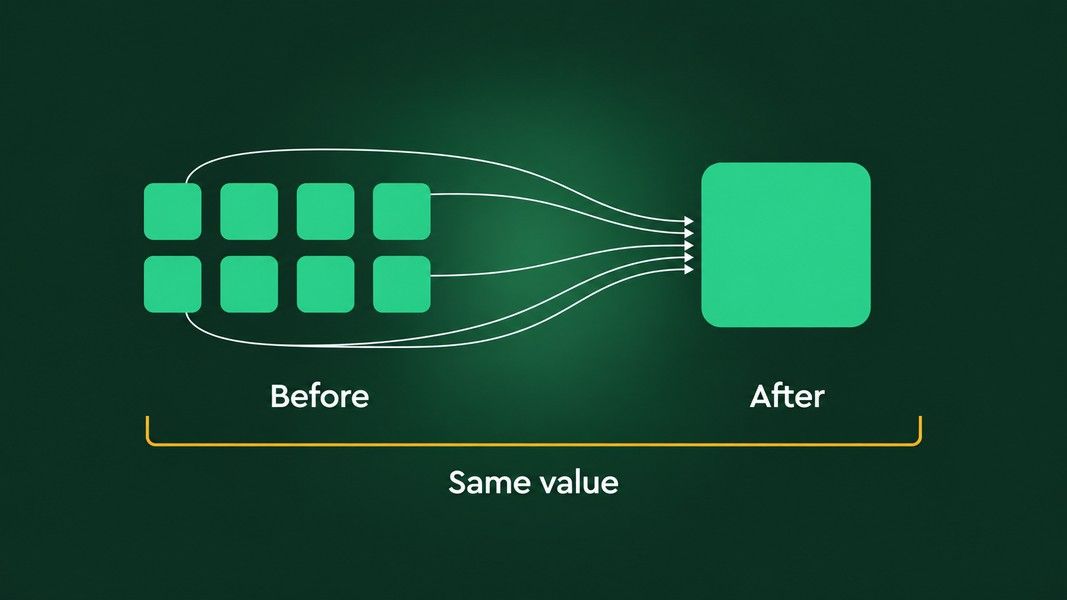
The share count fell by eight. The price rose by eight. Every per-share figure was multiplied by eight, which is where people get confused. GE's third quarter release in October 2021 restated its full-year outlook for earnings per share from 0.15 to 0.25 dollars into 1.20 to 2.00 dollars, and said plainly that the change came from the reverse split. If you read earnings per share across that date without knowing about the split, the company appears to have earned eight times as much overnight.
The dividend behaved the same way. GE's board declared 0.08 dollars per share in September 2021, against 0.01 dollars before. The payout per dollar invested did not change.
What did not move was the size of the company. Fox Business put GE's market capitalization at 113.8 billion dollars before and after the split. Your cost basis per share was multiplied by eight too, so the total you paid for the position stayed exactly what it was.
Why most reverse splits are a warning sign
GE's reason was housekeeping. Most companies that do this have a less comfortable one.
Nasdaq requires a listed stock to keep a closing bid of at least 1 dollar. Thirty business days below it and the company gets a deficiency notice and a 180-day window to fix it. The fastest fix is a reverse split, and that is why the investor.gov definition names exchange minimum bid rules as one of the main reasons for doing one.
So many companies leaned on that fix that the exchanges tightened it. Under Nasdaq's current listing rules, a company that falls below a dollar again after a reverse split in the prior year, or after splits adding up to 250 to 1 or more over two years, gets no compliance period at all. A comment letter filed with the SEC on a parallel NYSE rule counted 495 reverse splits of exchange-listed stocks in 2023, the most on record, against 288 in 2022.
What the research found afterwards
The long-run record is not kind. Hemang Desai and Prem Jain studied 76 reverse split announcements from 1976 to 1991 in a Journal of Business paper. On average those stocks trailed comparable stocks by 10.76% over the following year and by 33.90% over three years. That is a measured average of one past sample, not a forecast for any stock, but it explains why traders flinch at the words "reverse split".
The question to ask is not whether a company did a reverse split, but why. A company cutting its share count after shrinking on purpose is a different story from one trying to stay listed.
What followed, and what nobody could read on August 2
Three months after the split, on November 9, 2021, GE announced it would break itself into three public companies: aviation, healthcare and energy. Nothing in the reverse split filings said that was coming.
GE HealthCare was spun off on January 4, 2023 and began trading on Nasdaq as GEHC. GE Vernova, the energy business, followed on April 2, 2024, with one GEV share for every four GE shares, again with cash in place of fractional shares. What was left of General Electric now operates as GE Aerospace, still under the ticker GE.
Looking back, the reverse split reads like the first step of that plan: a share count sized for the company GE was about to become. A trader in August 2021 could see the stated reason and the timeline. They could not see the breakup, and anyone who says the split "signalled" it is reading the ending into the first chapter.
Reading a reverse split on a chart today
Pull up a GE chart covering 2021 today and you will not see a jump from 13 to 104 dollars. Most charting services adjust old prices for splits, and for spin-offs as well, so the line runs smoothly through August 2 at prices that never actually printed. The same adjustment is why you will not find the 1-for-8 ratio as a visible gap. The Nvidia stock split works the same way in the other direction.
That matters if you study patterns on old charts. A level that looks like support in adjusted history may never have been a price anyone traded at.
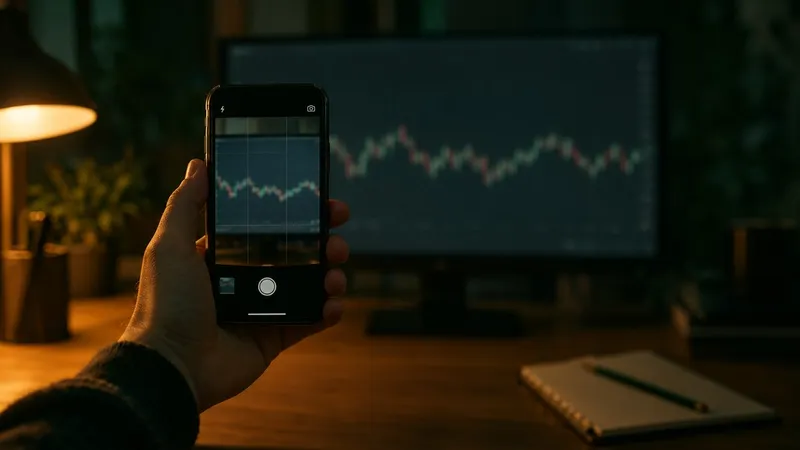
Primo Trade can read a chart from a photo or a screenshot and give an AI read of the trend, volatility, volume and the chart pattern it sees, along with a signal and a Primo Score. A screenshot does not say whether its history was adjusted for a split, so the AI reads the shape in front of it, not the corporate actions behind it. Searching the ticker instead brings recent news and financial metrics into the analysis, which is where news of an announced split or spin-off can appear.
Primo Trade gives AI-generated analysis for information and education. It is not financial advice. Markets carry risk; do your own research before you trade.
How to read a reverse split announcement
When a company you follow announces one, a few questions sort the housekeeping cases from the rescue cases.
- The stated reason: "Align our share count with our size" and "regain compliance with the minimum bid price" are very different sentences.
- The current price: A stock near a dollar on Nasdaq or the NYSE is on the clock; a stock at 13 dollars is not.
- Prior splits: A second reverse split within two years is a pattern the exchanges now treat as a red flag.
- The ratio: One for eight is modest. One for 200 usually means the price has fallen a very long way.
- Fractional shares: Check whether small holders are cashed out, since that can end a small position entirely.
Primo Trade's ticker analysis can give you a second read on the fundamentals and recent news around a stock like this, but the filing itself is the primary source. Read the 8-K.
What GE's reverse split shows
A reverse stock split changes the number of shares and the price per share by the same factor and leaves the value of your position where it was. GE's 1-for-8 in 2021 cut about 8.8 billion shares to 1.1 billion, moved the price from 12.95 to 103.60 dollars, multiplied every per-share figure by eight, and left a 113.8 billion dollar company exactly as large as it had been.
Most reverse splits are a response to a falling price and a listing rule, and the research on them is unflattering. GE's was a reset after years of shrinking, followed three months later by a breakup no filing had hinted at. The split itself told you nothing about the stock's direction. Its stated reason told you a lot about the company's situation, and that is the part worth reading every time.