On Friday, June 7, 2024, one Nvidia share closed at $1,208.88. On Monday morning the same share showed about $121, and nothing about the company had changed over the weekend. That was the Nvidia stock split of 2024, a 10-for-1 split, and this post reads it after the fact: the window from the announcement on May 22, 2024 to the slide that August, what the filings and the chart showed then, what followed, and what nobody reading it at the time could have known.
If you have ever opened a long-term chart and seen a stock fall 90% overnight, or wondered whether a split is good news, this is the cleanest recent case to learn from. It is history, not a view on the stock today.
Nvidia stock split history: six splits since 2000
Nvidia has split its stock six times. The dates and ratios below come from the split history that Investing.com publishes, which in late September 2026 still listed June 2024 as the latest.
| Split date | Ratio | One share became |
|---|---|---|
| June 27, 2000 | 2-for-1 | 2 shares |
| September 12, 2001 | 2-for-1 | 2 shares |
| April 7, 2006 | 2-for-1 | 2 shares |
| September 11, 2007 | 3-for-2 | 1.5 shares |
| July 20, 2021 | 4-for-1 | 4 shares |
| June 10, 2024 | 10-for-1 | 10 shares |
Multiply down the last column and one share held since before the 2000 split is 480 shares today. That is also why old Nvidia prices look odd on any chart you pull up. The prices shown for 2001 or 2007 have been divided by every split that came after them, so they are not the prices anyone actually paid at the time.
Two of the six were large. The 4-for-1 in 2021 and the 10-for-1 in 2024 together turned one share into forty, and the 2024 split is the one with a clean, well-documented window around it.
How the 2024 split worked, date by date
Nvidia announced the split on May 22, 2024, in the same release as its quarterly results, and filed it with the SEC the same day. Its own investor FAQ sets out the mechanics, and a Form 8-K filed on June 7 confirmed them.
- May 22, 2024: a ten-for-one forward split announced, plus a 150% increase in the quarterly dividend, from $0.04 to $0.10 per share.
- June 6, 2024: the record date. Holders at that close were entitled to nine additional shares for every share they owned.
- June 7, 2024: the split took effect at 4:01 p.m. Eastern, and authorized shares went from 8 billion to 80 billion. The new shares were distributed after the close.
- June 10, 2024: the first day of trading on a split-adjusted basis.
- June 28, 2024: the raised dividend paid, $0.01 per share on the new count.
Look at the dividend. $0.10 on one old share and $0.01 on each of ten new shares is the same ten cents. The 150% increase was real, but the split did not create it; it only changed the unit it was counted in. Options were adjusted too, under a memo from the Options Clearing Corporation, so a contract holder was neither helped nor hurt by the arithmetic.
The FAQ put the purpose plainly: a lower price that is more affordable for employees and investors, with every holder keeping the same proportionate interest in the company.
What the chart showed on June 10
Yahoo Finance reported that Friday's close of $1,208.88 was revised to $120.88 when trading opened Monday on the new basis. Investopedia reported the stock finished that first day 0.8% higher, at $121.79.
The revision matters more than the 0.8%. Data providers rewrite every earlier price by dividing it by the split ratio, so the long-term line stays continuous. A source that does not adjust shows something else entirely: a cliff of roughly 90% in one session that never happened to anyone's money.
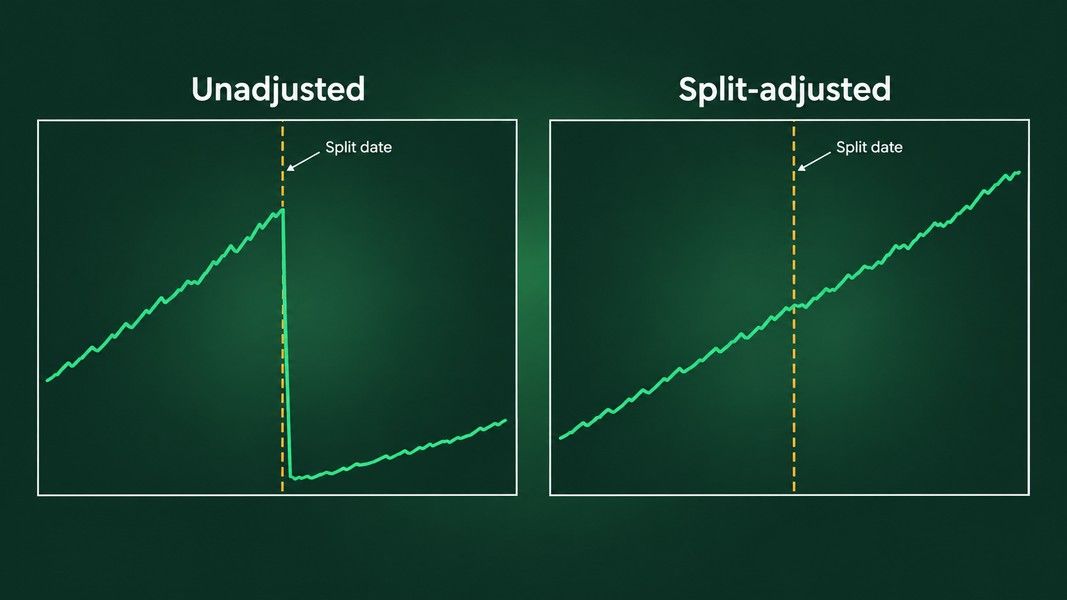
If a line drops by a clean ratio overnight, a half, a quarter, nine tenths, and then carries on as if nothing happened, look for a split before you look for a crash. The same goes for candles. The patterns in reading candlestick charts only mean something on a series where yesterday's prices and today's are in the same unit.
This is also where a picture of a chart reaches its limit. When you photograph a chart for Primo Trade, the AI reads what is in the frame: the trend, the volatility, the volume and the chart pattern it sees. A split is a corporate action, not a pattern, so whether a series was adjusted is a question for the chart's source, not for whoever, or whatever, reads the picture.
What followed: a record, then a 25% slide
Eight days after the split, on June 18, 2024, Nvidia closed up 3.5% at $135.58. That put its market value above $3.34 trillion and made it the world's most valuable listed company, ahead of Microsoft, as DCD and The Guardian reported that day.
It did not hold. Forbes reported on June 24 that the stock had fallen 12% from that record close in four sessions, trading around $120, its lowest intraday level since the split day. By August 8, Bloomberg reported the shares had slumped 25% from the mid-June high, roughly $900 billion of market value.
Within two months of a split that a lot of people read as a bullish sign, the stock had set a record and then lost a quarter of its value from it. Neither move says much about splits. Bloomberg's own explanation in August pointed to a stock without a catalyst ahead of an earnings report due at the end of the month.
A reader who treated the split as the story would have been wrong twice: once on the way up, crediting the split with a rally the business was driving, and once on the way down, expecting the "split effect" to cushion a drop it had nothing to do with.
What the split changed and what it left alone
Five months later the split did have one mechanical consequence. On November 1, 2024, S&P Dow Jones Indices announced that Nvidia would replace Intel in the Dow Jones Industrial Average from November 8, as Euronews reported.
The Dow is price-weighted: a member's pull on the index depends on its share price, not on the size of the company. A $1,200 share would have swung the index far more than its peers. Euronews noted that the split reduced Nvidia's influence on the index's movements, and so made its inclusion workable.
| What the split changed | What it left alone |
|---|---|
| Price per share, divided by ten | Nvidia's total market value |
| Share count, multiplied by ten | Each holder's proportional stake |
| Dividend per share, now $0.01 | Revenue, earnings and cash flow |
| Option contracts, adjusted by the OCC | The demand for AI chips behind the price |
| Fit for a price-weighted index | Where the stock went next |
Everything in the left column is arithmetic or eligibility; everything in the right column is what actually moves a stock.
What a reading at the time could not separate
The hardest part of this case is the date. The split was announced in the same release as quarterly results in which, as DCD reported, revenue reached $26 billion, up 262% from a year earlier. Anyone reading the stock after May 22 was reading the earnings and the split at once, with no way to tell which did what.
Research on splits runs into the same problem at scale. In a 1996 study of 1,275 two-for-one splits, Ikenberry, Rankine and Stice found the stocks moved 3.38% on the announcement and ran 7.93% ahead of comparable stocks in the first year after the split. Their reading was not that splits create value. Managers decide to split when they expect the business to do well, so the split carries management's view, and the price follows the business.
A 2009 paper in the Journal of Empirical Finance by Huang, Liano and Pan came at it from the other side. Splitting firms showed no better operating performance than non-splitting firms over the next four years, and the authors tied the announcement effect to lower share prices and better liquidity rather than to any signal.
Both are averages of past samples, measured over other stocks in other years, and neither is a forecast for the next split. The 2024 Nvidia window is a good illustration of why: the split was in every headline, while the business and the expectations around it did the moving.
Reading a split stock without being fooled by it
The lessons from this window fit in a short list.
- Check whether the chart is split-adjusted before you read anything into a sudden drop.
- Put the split date beside the earnings date. When they coincide, the move belongs to both and you cannot pull them apart.
- Read per-share numbers, earnings per share and dividends, on the new share count, never against the old one.
- Treat a split as corporate housekeeping, not as a chart pattern or a sign of where the price goes.
The question that matters after a split is the same one that mattered before it: what the business and the market's expectations are doing. A ticker analysis in Primo Trade puts that context next to the chart, prices, recent news and financial metrics in one read, with a signal that is the AI's directional view of the data, never an instruction. If you want to see where that kind of reading goes wrong, the post on how AI reads a stock chart covers the failure cases.
Primo Trade gives AI-generated analysis for information and education. It is not financial advice. Markets carry risk; do your own research before you trade.
What the 2024 split leaves you with
A split divides the price, multiplies the share count and leaves the company's value and every holder's stake where they were. Nvidia's 2024 split did exactly that: $1,208.88 became $120.88 overnight, and the dividend changed its unit without changing its size.
The first practical consequence is on the chart. Data providers rewrite the past to keep the line continuous, and a chart that has not been adjusted shows a crash that never happened.
What followed the split, a record close eight days later and a 25% slide by August, came from the business and the expectations around it, not from the split. The one real consequence of the split itself was eligibility for a price-weighted index, which arrived in November.
Research averages over past samples describe management's choice to split more than any power in the split, and they describe other stocks in other years. Read the split as housekeeping and the business as the story.