You look up TSMC in a US broker app and get TSM at $457.99. The Taipei quote for the same company says NT$2,550. You multiply, you convert, and the two still disagree by almost 15%. Nobody made a typo: you are looking at an ADR stock, and its price carries a gap of its own.
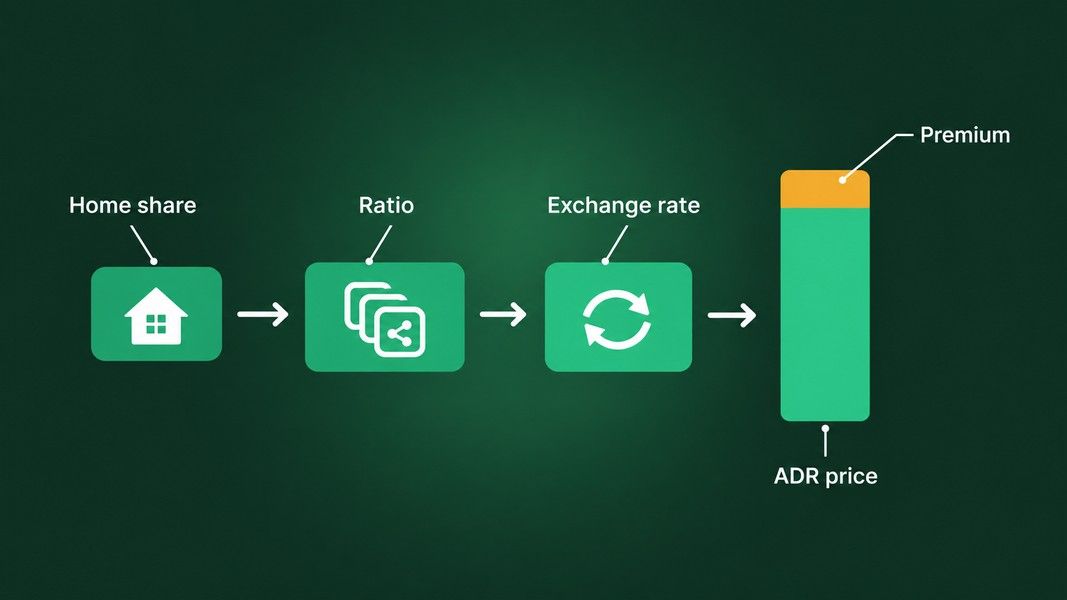
An ADR stock, short for American depositary receipt, is a US-listed, dollar-priced certificate for shares of a foreign company that a depositary bank holds in the home country. Its fair comparison with the home share is the home price times the ADR ratio, divided by the exchange rate; whatever is left over is a premium or a discount. That leftover can move faster than the company itself.
This guide walks through the comparison in six steps with two real, dated examples, then covers the fees and the timing traps that make ADR prices look stranger than they are.
What an ADR Stock Actually Is
A US bank, the depositary, holds the foreign shares through a custodian abroad and issues receipts that trade and settle like any US stock, in dollars. The SEC's investor bulletin on ADRs notes that the first one was created in 1927 so Americans could own a British department store, and it counted more than 2,000 ADRs from more than 70 countries. You will also see ADS, for American depositary share. Strictly, the ADS is the share and the ADR is the certificate, but almost everyone uses the two as one word.
Not every ADR is built the same way. A sponsored ADR is set up by the company with one depositary bank. An unsponsored one is set up without the company's cooperation, usually because a broker wants a US market in the stock. The SEC groups programs into three levels:
| Level | Where it trades | Can raise capital in the US | What the company files |
|---|---|---|---|
| Level 1 | Over the counter only | No | Form F-6 only; little or nothing on EDGAR |
| Level 2 | A US exchange | No | Annual report on Form 20-F |
| Level 3 | A US exchange | Yes | Form 20-F plus an offering registration |
If an ADR trades on the NYSE or Nasdaq, it is at least Level 2, so the company files an annual report you can read on EDGAR. Unsponsored programs can only be Level 1, which means over the counter and thinner disclosure.
What You'll Need Before You Compare
The comparison takes four numbers, all for the same date:
- The ADR ratio: how many home shares one ADR represents.
- The home-market closing price, in local currency.
- The exchange rate for that day, in local currency per US dollar.
- The ADR's closing price in New York.
One caution before the math. Taipei closes at 1:30 p.m. local time, which is 1:30 a.m. in New York during US daylight saving time, so the two sessions never overlap. Mumbai closes before New York opens as well. A "same-day" premium is always a comparison of two prices taken hours apart, so the trend tells you more than the second decimal.
How to Compare an ADR Stock Price With the Home Share
Step 1: Find the ADR ratio
The ratio is printed by the company itself. HDFC Bank's investor relations page states one ADR equals three ordinary shares, with JPMorgan as depositary, and explains that the ratio exists to price the ADR in a range typical for its US peers. TSMC's annual report on Form 20-F says each ADS represents five common shares.
| Company | US ticker | Home shares per ADR |
|---|---|---|
| TSMC | TSM | 5 |
| HDFC Bank | HDB | 3 |
| ICICI Bank | IBN | 2 |
| Infosys | INFY | 1 |
| Alibaba | BABA | 8 |
| Toyota | TM | 10 |
Ratios change. Sify's ADR went from one share to six in October 2024, so a ratio copied from an old article can throw the whole calculation off by a round multiple.
Step 2: Take the home-market close
Use the official close on the home exchange for your date, in local currency. For TSMC that is ticker 2330 on the Taiwan Stock Exchange, where the shares have been listed since 1994; the ADS joined the NYSE in 1997.
Step 3: Convert at that day's exchange rate
The Federal Reserve's H.10 release publishes a daily rate for major currencies, and it is the cleanest public source for a past date. Write it as local currency per dollar, for example 31.94 New Taiwan dollars per US dollar.
Step 4: Compute the home-equivalent value
The formula is home price times ratio, divided by the exchange rate. With the figures for October 8, 2026 used in a Tickwise worked example: 2,550 times 5, divided by 31.94, gives about $399.19. That is what five Taipei shares were worth in dollars at the close.
Step 5: Read the premium or discount
Divide the ADR price by the home-equivalent value and subtract one. TSM closed that day at $457.99, so the premium was about 14.7%. A premium means you pay more in New York for the same claim on the company than the home market charges.
The size of the gap differs a lot by stock. Platizio Global calculated that HDB closed 3.6% above its Mumbai price on October 16, 2026, and that it has usually held a premium of a few percent over the past year. Most of the large Indian ADRs traded within a few percent of parity that day.
Step 6: Ask whether the gap can close
A gap stays small when professionals can convert freely. Holders can surrender ADRs for the underlying shares, and shares can be deposited to create new ADRs; brokers usually do this, rarely individuals. Alibaba says its US ADSs and Hong Kong shares are fully fungible in both directions, which keeps the two lines close.
When conversion is blocked, nothing forces the prices together. TSMC ordinary shares cannot be freely converted into ADRs, and India's foreign holding limits cap how many new ADRs can be created for HDFC Bank. A premium that cannot be arbitraged away can also shrink on its own, and the ADR holder absorbs that move.
Worked Example: One Week in TSM
Here is what that last sentence looks like with numbers. The October 16 exchange rate is a third-party rate, as Tickwise notes; the rest are official closes.
| Oct 8, 2026 | Oct 16, 2026 | Change | |
|---|---|---|---|
| 2330 close in Taipei | NT$2,550 | NT$2,420 | -5.1% |
| NT$ per US dollar | 31.94 | 32.33 | NT$ weaker |
| Home value of one TSM | $399.19 | $374.27 | -6.2% |
| TSM close in New York | $457.99 | $412.61 | -9.9% |
| Premium | 14.7% | 10.2% | -4.5 points |
The company's shares fell about 5% in Taipei. Someone holding those shares and counting in dollars was down about 6%, because the currency weakened too. TSM fell almost 10%, because on top of both, the premium itself shrank from 14.7% to 10.2%.
So an ADR's move is roughly the home move, times the currency move, times the change in the premium. You take all three at once. Bloomberg data cited by Tickwise put the TSM premium at an average of about 26% in December 2025 and about 13.7% in May 2026, which shows how far that third part can travel on its own.
This is a closed window read after the fact, not a view on TSM today.
What the Fees Take
ADR fees are small per share and easy to miss. TSMC's 20-F lists up to $0.05 per ADS for issuing or cancelling ADSs and up to $0.02 per ADS for distributing cash proceeds such as sold rights. Brokers usually pass the issue and cancel fees on to the client.
Then there is the custody fee for holding the receipt at all. The SEC's bulletin explains that depositaries commonly deduct it from the dividend before you see it. DTC's fee schedule describes the pass-through custody fee as typically $0.02 per share a year. For ADRs that pay no dividend, DTC charges your broker instead, and brokers such as Firstrade show it on the statement as an "ADR Pass-Thru Charge."
Dividends also meet the home country's tax first. TSM's October 2026 payment, per Citibank's notice as summarised by Tickwise, went like this: NT$7 per share, times five, is NT$35 per ADR; converted at 31.927 that is a gross $1.0963; Taiwan withholds 21%, leaving about $0.866 per ADR. On an ADR, the dividend you receive is net of a currency conversion, a foreign tax and sometimes a depositary fee.
Tips for Reading ADR Stock Prices
Expect the ADR to move while the home market sleeps
News that lands after the home close shows up in the ADR first. On December 19, 2025, Infosys ADRs jumped as much as 56% to $30 soon after the New York open and triggered two Limit Up Limit Down pauses, Business Standard reported. Infosys said nothing material lay behind it, and its Mumbai shares had closed that day up 0.81%.
Put a ceiling on what you pay
A spike like that is why a market order in a thin ADR is a gamble on the fill. A limit order caps the price, at the cost of maybe not filling at all.
Treat extended hours with extra care
ADRs also trade outside the regular session, where quotes are thinner still. The rules for after-hours trading apply to them like any other US stock.
Watch the premium's trend, not one day
Because the two closes are hours apart, a premium that flips between plus and minus one percent is mostly timing noise. A premium that drifts from 26% to 10% over months is a real change in what New York is willing to pay.
Troubleshooting Common Issues
- The numbers are off by a round multiple. The ratio is wrong or has changed. Check the depositary's latest notice or the company's latest 20-F.
- The listing is not an ADR at all. ASML's Nasdaq line is ordinary shares held through a New York transfer agent, not a depositary receipt, so the ratio and fee steps do not apply.
- The ticker has five letters and trades over the counter. Foreign securities quoted over the counter often do, and they may be Level 1 or unsponsored, with thinner disclosure and voting rights that may not pass through.
- The dividend is smaller than you expected. Look for home-country withholding and a custody fee taken before payment.
Where Primo Trade Fits
Primo Trade analyzes US-listed stocks and ADRs from a ticker, out of an autocomplete of about 16,000 symbols. For an ADR such as TSM or HDB, the AI reads the New York line: its prices, recent news and financial metrics. It then gives a signal, a Primo Score and a Trading Strategy as its read of that data, not as an instruction. It does not compute the premium against the home share, so the six steps above stay yours to run, and it refuses an ADR its data cannot price rather than guessing.
Primo Trade gives AI-generated analysis for information and education. It is not financial advice. Markets carry risk; do your own research before you trade.
The Short Version
An ADR stock is a dollar receipt for foreign shares held by a US bank. To compare it with the home share, multiply the home close by the ratio, divide by the exchange rate, and the leftover is the premium or discount.
That premium is a third moving part beside the company and the currency. Where conversion is free, it stays small; where it is blocked, as with TSMC and HDFC Bank, it can sit in double digits and shrink without warning, as it did by 4.5 points in one week of October 2026. Add the custody fees and home-country withholding, and an ADR is the same company with a few extra numbers attached, worth reading before the trade rather than after.