It is 10:40 on a Tuesday, you are stuck in a meeting, and the stock you bought at the open is moving. If that thought tightens your stomach, the choice between swing trading vs day trading may already be made for you. Day trading opens and closes every position inside one trading session. Swing trading holds a position for days or weeks, so it rides through nights, weekends and whatever news lands in between.
Neither one is the easy option. They swap one set of risks for another: day traders take on speed, costs and long hours in front of a screen, while swing traders take on the gap between one close and the next open.
This guide puts the two side by side, explains what changed when the $25,000 pattern day trader rule ended in June 2026, and looks at what the research found about people who day trade for years.
Swing Trading vs Day Trading at a Glance
If you only have a minute, this is the comparison in one place.
| Day trading | Swing trading | |
|---|---|---|
| Holding time | Minutes to hours, flat by the close | Days to a few weeks |
| Screen time | Most of the session | A check before or after the session |
| Charts most used | 1-minute to 15-minute | Daily, sometimes 4-hour |
| Main risk | Fast moves, costs, overtrading | Overnight and weekend gaps |
| Trades per week | Many | A handful |
| Fits best | Someone free to watch the whole session | Someone with a day job |
The real question is not which style is better, but which risk you can live with: the one you watch, or the one that happens while you sleep.
The rest of this guide goes through each row, because every one of them hides a detail that the table cannot show.
What Day Trading Actually Means
A day trader buys and sells the same stock within the same session and goes home with no open positions. The SEC's investor guide puts the reason bluntly: true day traders do not hold stocks overnight because of the risk that prices change radically from one day to the next.
That one choice shapes everything else. The moves a day trader works with are small, often a fraction of the stock's daily range, so each trade needs a clean entry, a fast exit and a tight plan for when it goes wrong. Spreads and fees are paid on every round trip, and a day with many trades pays them many times.
The same SEC guide describes day trading as an extremely stressful and expensive full-time job, where the trader has to watch the market continuously. That is not a figure of speech. A setup on a 5-minute chart can form and fail inside a quarter of an hour, and nobody catches that between emails.
What Swing Trading Actually Means
A swing trader tries to catch one leg of a larger move: a pullback inside an uptrend, a bounce off a level that held before, a breakout that keeps going for a few sessions. The position stays open for days, sometimes a few weeks, and closes when the move plays out or price shows the idea was wrong.
Because each candle on a daily chart is a full session, a swing trader can do most of the work in the evening. If daily candles still look like noise to you, start with how to read candlestick charts, since the whole style is built on reading them one day at a time.
The cost of that calm is exposure. A swing position is open while the market is closed, and the market does not wait for you to wake up before it reprices a stock. Earnings releases, guidance cuts, sector news and broad market shocks all tend to arrive outside the regular session.
Time: The Difference You Feel First
For most people the decision is made by the calendar long before risk comes into it.
Day trading is a schedule. The open is often the most active part of the session, and it is also when most jobs start. A day trader who misses the open misses a large part of the day's action, and one who trades it while distracted is guessing.
Swing trading fits around a day job. A typical routine is twenty minutes after the close: scan the daily charts, check which open positions are still behaving, and set or adjust orders for the next session. The orders do the waiting so you do not have to.
There is a catch on the swing side too. You still need to know what is on the calendar for every stock you hold. An earnings release during a swing trade is not a detail; it is the single biggest overnight gap risk you will knowingly carry. One option is to close or shrink a position before the report and decide again once the numbers are out.
Risk: Overnight Gaps Against Intraday Speed
A day trader's risk is mostly visible. Price moves while you watch, and a stop sits close to the entry. The trouble is that tight stops on short charts get hit by ordinary noise, so a day trader can be right about direction and still be stopped out three times before the move starts.
A swing trader's risk is mostly invisible. Say a stock closes at $50 and your stop sits at $47. Overnight the company lowers its guidance and the stock opens at $44. Your stop did not protect $47, because there was never a trade at $47.
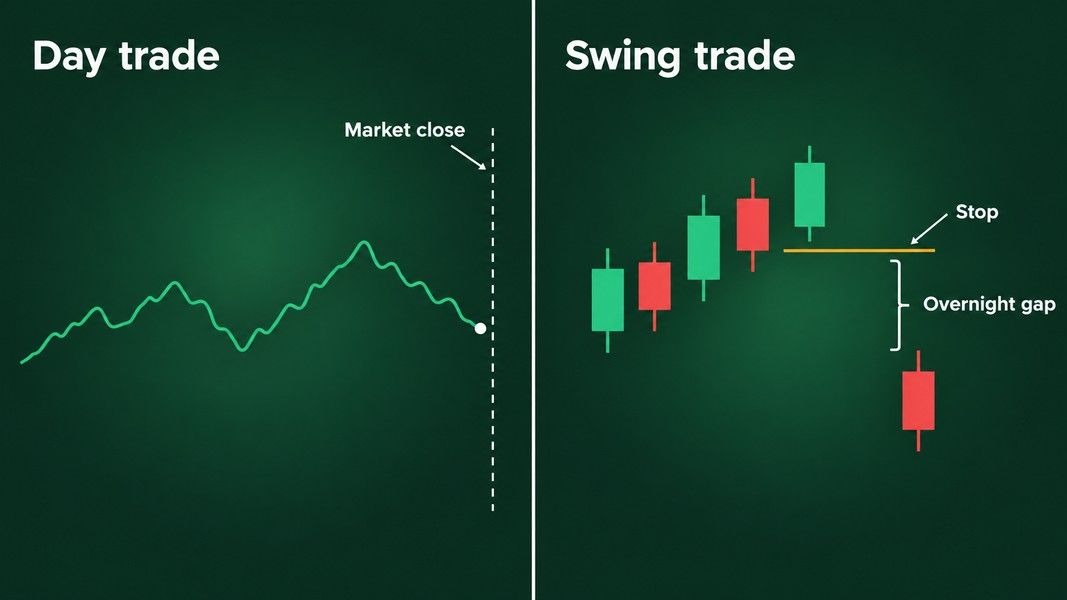
FINRA's guidance on stop orders spells out why. A stop price is a trigger, not an execution price: once triggered, a stop order becomes a market order and fills at the current market price, which can be very different from the stop price when the market is moving fast. A stop-limit order controls the price, but FINRA warns it may then not execute at all.
None of this makes stops useless. It means a swing trader sizes each trade knowing the real worst case is the gap, not the stop. The guide on stop, stop-limit and trailing stops walks through each order type with this exact problem in mind.
The $25,000 Rule Is Gone, the Margin Math Is Not
For more than twenty years, many small accounts became swing traders by default. Under the old rule, four or more day trades within five business days in a margin account made you a pattern day trader, and a pattern day trader needed at least $25,000 in the account.
That rule is over. The SEC approved FINRA's change on April 14, 2026, and FINRA's Regulatory Notice 26-10 replaces the day trade count and the $25,000 minimum in their entirety. The new rules took effect on June 4, 2026, but brokers may phase them in until October 20, 2027, so yours may still run the old system for a while.
What replaced it is an intraday margin standard. For margin accounts, the broker works out the largest shortfall that day between the margin required and the account equity, called an intraday margin deficit. You are expected to cover it as promptly as possible, and it stays outstanding for up to 15 business days. If you make a practice of leaving deficits unpaid past the fifth business day, the broker must stop you from adding new debit balances or short positions for 90 days. Small deficits, up to the lesser of 5% of the account's equity or $1,000, do not count toward that practice.
So the barrier that pushed small accounts toward swing trading is gone. The choice now rests where it always should have: on your time, your temperament and which risk you would rather carry.
What Research Found About People Who Day Trade
Ending the $25,000 rule made day trading easier to start, not easier to do well.
Brad Barber, Yi-Tsung Lee, Yu-Jane Liu and Terrance Odean used the complete trading records of the Taiwan Stock Exchange from 1992 to 2006, where day traders made up 17% of all volume. Their Taiwan study found that fewer than 1% of day traders came out ahead after fees in a way that held up reliably from one year to the next.
A team from FGV and the University of São Paulo followed everyone who started day trading Brazilian equity futures between 2013 and 2015. Among the people who kept at it for more than 300 days, the Brazilian study found that 97% lost money. Only 1.1% took home more than the Brazilian minimum wage, and the authors found no evidence that people got better by doing it longer.
FINRA requires brokers that promote day trading to hand customers a risk disclosure, and it says that day trading can be extremely risky and that you should be prepared to lose all of the funds you use for it.
Two honest limits. These are other markets and other years, and this research found no study of swing traders on a similar scale, so none of it shows that swing trading does better. What it does show is how hard the fastest version of the game is for individuals competing against professional firms.
The Charts Each Style Reads
The same stock looks like a different animal depending on the timeframe you open.
A day trader lives on 1-minute, 5-minute and 15-minute charts. Volume in the first hour, the previous day's high and low, and the opening range carry most of the weight. Patterns form and resolve within the session, and a lot of what shows up is noise that only looks like a pattern.
A swing trader starts on the daily chart and often checks the weekly for direction. Classic chart patterns such as flags, double bottoms and cup and handle formations take days or weeks to build. A bull flag on a 5-minute chart shares the name and not much else.
Pick the chart that matches how long you plan to hold, and judge the setup only on that chart. A daily uptrend can contain a brutal 5-minute selloff, and a beautiful 5-minute breakout can be a blip inside a daily downtrend.
Which Style Fits You
The table at the top gives the short answer. The longer one depends on a few honest questions about your week and your nerves.
- You work a regular job and check the market at lunch. Swing trading on daily charts fits the hours you actually have. Day trading in stolen minutes tends to mean late entries and missed exits.
- You can watch the full session and follow written rules for every trade. Day trading is at least possible to attempt, and the research above is the base rate you are trading against.
- A gap down against your position would keep you up at night. Smaller swing positions, closing before earnings, or longer holding periods with wider stops may suit you better than either extreme.
- You are still learning to read charts. Daily charts are slower, cleaner and forgiving of a late look, which makes them the better classroom.
Nothing stops you from mixing the two: mostly swing trades, with the occasional same-day exit when a position hits its target faster than planned. That is not a style crisis; it is what happens when the trade, not the label, decides.
Where an AI Read Fits In
Whichever style you lean towards, the hard part is the same: deciding whether a setup is worth your time at all, on the timeframe you actually trade.
Primo Trade's AI analysis includes a Trading Strategy section that names Day Trading, Swing Trading, Position Trading, Long-Term Hold or Avoid, along with a risk level and two or three action points written as text. Read the label as the AI's view of which timeframe the data in front of it suits, a second opinion to set beside your own read, not a verdict on what to do.
Primo Trade gives AI-generated analysis for information and education. It is not financial advice. Markets carry risk; do your own research before you trade.
For swing traders the chart photo path is the more natural one. Take a photo or screenshot of a daily chart from your broker, and Primo Trade reads the trend, volatility, volume and the chart pattern it sees, along with what that pattern usually signals. It does not know what the company will report next week, which is exactly the gap risk this guide is about.
The Short Version
Day trading and swing trading are not beginner and advanced versions of the same thing. They are different jobs with different hours and different ways of losing money.
Day trading demands the full session, many decisions and a cost on every round trip, and the largest studies of real accounts found that only a tiny share of day traders come out ahead after fees with any consistency. Swing trading fits around a normal day, works off daily charts and moves at a pace you can think at, but it carries the overnight gap, where a stop order can fill well below its price.
The $25,000 pattern day trader rule ended in June 2026, with brokers allowed until October 2027 to switch, so account size no longer makes the choice for you. Your schedule, your temperament and the risk you can sit with still do.