

You have a $6,000 margin account, you closed three trades the same day they opened this week, and on Thursday a fourth one moves fast. For more than two decades, that fourth exit was the one that could freeze your account. The pattern day trader rule said four day trades in five business days made you a pattern day trader, and a pattern day trader needed $25,000 in the account.
That rule is gone. FINRA replaced it, along with the $25,000 minimum, with an intraday margin standard that took effect on June 4, 2026. No one counts your day trades any more. Your broker checks whether your equity covers your open positions during the day, and that is a different kind of test with its own way to trip you up.
This guide covers what the old rule said, what the new one measures, the $2,000 floor that did not move, the transition that runs until October 2027, and the cash account rules that were never part of any of this.
What the Pattern Day Trader Rule Used to Say
The old rule is still what most search results describe, so it helps to know exactly what ended.
A day trade, in FINRA's definition, is buying and selling the same security on the same day in a margin account, or selling short and buying to cover on the same day. Options count. Holding a position overnight and selling it the next morning does not.
Under the old rule, a customer who made four or more day trades within five business days was a pattern day trader, as long as those day trades were more than six percent of the customer's trades in that margin account over the same five days. According to the SEC's Investor.gov glossary, a pattern day trader had to hold at least $25,000 in the account, deposited before any day trading and kept there at all times. In return, the account got day trading buying power of up to four times the maintenance margin excess at the previous close.
The rule did not judge risk; it counted trades. An account with $24,000 and one careful trade a day could be locked out, while a $30,000 account could day trade as heavily as its buying power allowed.
What Replaced It: Intraday Margin in Plain Words
FINRA's Regulatory Notice 26-10, published on April 20, 2026, replaces the day trading margin requirements in their entirety: the trade count, the pattern day trader label and the $25,000 minimum. The SEC approved the change on April 14, 2026.
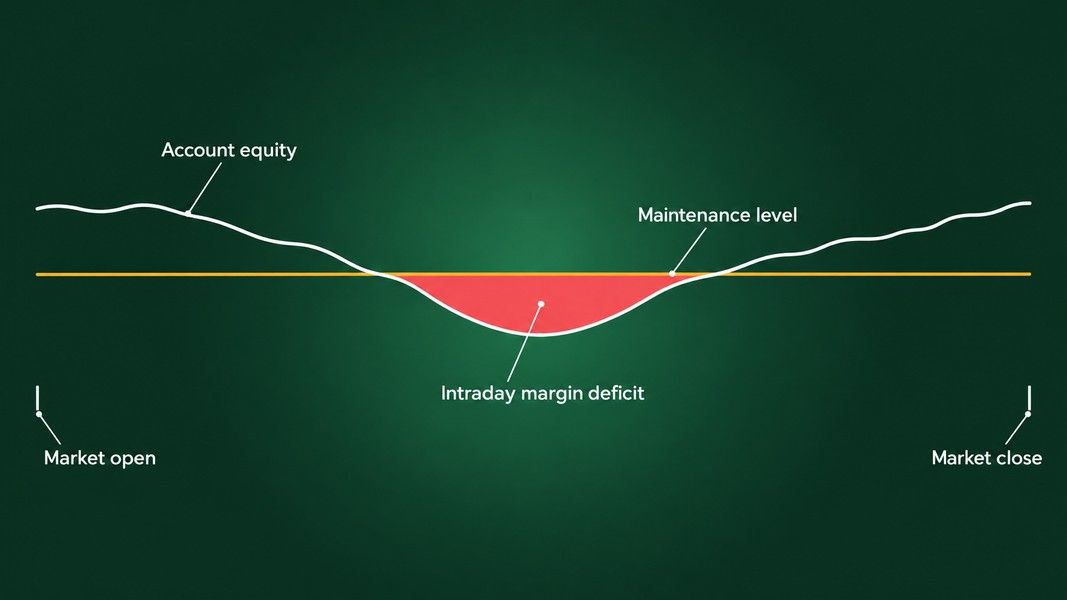
The new standard asks a different question. Instead of how many round trips you made, it asks whether your account kept enough equity for the positions it held at any point in the day.
The baseline did not change. Maintenance margin for most stocks is still equity of at least 25 percent of the market value of the long positions in the margin account, and your broker can ask for more. What changed is that this level now applies throughout the trading day, not only at the close.
What Happens After an Intraday Margin Deficit
When a trade leaves the account below that level, the shortfall is an intraday margin deficit. FINRA's notice sets out what follows:
- You cover it as promptly as possible, with a deposit or by closing positions. A deficit stays outstanding until it is covered or until the close of business on the 15th business day after it occurred.
- A habit of leaving deficits unpaid has a cost. If you make a practice of it and a deficit is still open at the close of the fifth business day, the broker must stop you from adding to a debit balance or a short position for 90 calendar days, or until that deficit is covered.
- Small deficits do not count toward that practice. A deficit no larger than the lesser of 5 percent of the account's equity or $1,000 is ignored for this test.
Brokers can enforce this in two ways. They can watch accounts in real time and block a trade that would create or increase a deficit, or they can run one calculation at the end of the day and call for margin from accounts that fell short. Some use a combination of the two.
Old Rule and New Rule Side by Side
Most of the change fits in one table.
| Old pattern day trader rule | Intraday margin standard | |
|---|---|---|
| What triggers it | Four or more day trades in five business days | Equity below the maintenance level during the day |
| Account label | Pattern day trader | None |
| Minimum equity | $25,000 to day trade | $2,000 to trade on margin |
| When it is checked | By trade count over five days | During the day or once at the close |
| Penalty for repeated failures | Account restrictions | Up to 90 days without new margin debt or shorts |
The $2,000 Floor Did Not Move
It is easy to read the change as if day trading on margin now has no minimum at all. It does have one. FINRA's investor guide on intraday margin requirements states that $2,000 is the minimum equity needed to trade on margin.
Below $2,000 you can still trade in a margin account, but only with the cash you actually have, with nothing borrowed. Brokers can also set higher minimums of their own, usually called house requirements, so the number your broker shows you may be larger than FINRA's.
So the old cliff at $25,000 became a much lower step at $2,000. The amount of money you need to day trade on margin fell; the rules about borrowed money did not soften.
A Worked Example: One Busy Day in a $5,000 Account
Numbers make the new standard easier to picture. This is a simplified illustration, and your broker's calculation will include details it leaves out.
Charles Schwab, one of the large brokers that switched early, describes the new intraday buying power as based on a default 25 percent maintenance requirement for most stocks. Its July 2026 explainer says this can give up to four times the buying power intraday, against the usual Regulation T limit of borrowing up to 50 percent for positions held overnight.
Say your account holds $5,000 of equity. At a 25 percent requirement, that equity supports up to $20,000 of stock during the day. Overnight, Regulation T supports about $10,000.
When the Stock Moves Against You
Now say you buy the full $20,000 in the morning and the stock drops 10 percent by early afternoon. The position is worth $18,000, and your equity has fallen to $3,000. The requirement at 25 percent is $4,500, so the account is $1,500 short. That is an intraday margin deficit, and it is well above the lesser of 5 percent of equity or $1,000, so it counts.
Two more things happen if you do nothing. A broker watching in real time may block your next trade. At Schwab, a position above your overnight buying power that is still open at the end of its trading day can bring a margin call. Four times the buying power also means a move against you hits your equity four times as hard. Schwab warns in the same explainer that you could lose more than you put in.
Your Broker May Still Be Counting
The rule took effect on June 4, 2026, but FINRA gave brokers that need more time until October 20, 2027 to switch. Until your broker moves, it may keep running the old pattern day trader system, so the $25,000 rule can still apply to your account even though it is gone from FINRA's rulebook.
Some large brokers moved early. Schwab stopped counting day trades on June 8 and introduced its intraday buying power on July 13, 2026. Fidelity's learning center says it no longer labels accounts as pattern day traders or counts day trades. Robinhood's support pages say accounts flagged under the old rule had the flag removed, that it monitors margin accounts in real time, and that the $2,000 minimum still applies.
The quickest check is your broker's own help page for "intraday margin" or "pattern day trader". If it still describes a day trade counter, you are on the old system for now.
Cash Accounts Never Had the Rule
The pattern day trader rule only ever applied to margin accounts, and so does its replacement. A cash account can day trade, and FINRA's guide to frequent intraday trading spells out the two traps that come with doing it there.
The first is free-riding: buying and selling a security before you have paid for it in full. It violates the Federal Reserve's Regulation T and can lead to strict account restrictions.
The second is a good faith violation: buying with proceeds from a sale that has not settled yet, then selling the new position before those proceeds settle. Most US stock trades now settle T+1, the next business day, so a sale on Monday frees its cash for a fresh purchase you can sell on Tuesday.
The practical rule for a cash account is to day trade only with settled cash. That keeps you clear of both violations, at the cost of fewer round trips per dollar.
What the Change Does Not Fix
Ending the $25,000 minimum made day trading easier to start. It did nothing to make it easier to do well, and the research on people who day trade for years is sobering. The comparison of swing trading vs day trading goes through the largest studies of real day trading accounts and what they found.
FINRA's own guidance is blunt about margin: frequent trading with borrowed money remains a high-risk activity, and you should only use money you can afford to lose. Before your first day trade under the new standard, three questions are worth an honest answer:
- Has your broker switched yet? If not, the old trade count still applies to you.
- Do you know both of your buying power numbers? Intraday buying power and overnight buying power are different, and only one of them survives the close.
- What is your plan for a deficit? Know whether you would deposit cash or close positions before it happens, not after.
Stops do not save you from a fast move either. A triggered stop becomes a market order, and the guide to stop and stop-limit orders explains why it can fill well below its price.
Where an AI Read Fits In
None of these rules tells you whether a setup is worth a trade in the first place. That part is still yours.
Primo Trade's AI analysis of a US-listed stock includes a Trading Strategy section that names Day Trading, Swing Trading, Position Trading, Long-Term Hold or Avoid, with a risk level and two or three action points written as text. Read it as the AI's view of which timeframe the data suits, a second opinion beside your own, not an instruction to trade.
Primo Trade gives AI-generated analysis for information and education. It is not financial advice. Markets carry risk; do your own research before you trade.
Primo Trade does not see your account. It knows nothing about your equity, your buying power or whether your broker still counts day trades, so the margin math in this guide stays with you and your broker.
The Short Version
The pattern day trader rule, with its count of four day trades in five business days and its $25,000 minimum, was replaced in its entirety on June 4, 2026. In its place is an intraday margin standard that checks whether your equity covers your positions during the day.
Margin trading still needs $2,000 in equity, maintenance margin still sits at 25 percent for most stocks, and repeated failures to cover intraday deficits can freeze new margin debt for 90 days. Brokers have until October 20, 2027 to switch, so the old rule may still apply where you trade. Cash accounts were never part of either rule, and settled cash keeps them clear of free-riding and good faith violations.