You buy 500 shares, the stock ticks up three cents in under a minute, you sell, and the account shows a loss. The chart did exactly what you expected. What you met was the bid-ask spread, and in scalping trading it is the first thing every trade has to pay.
Scalping trading is a style where you hold a stock for seconds or minutes, aim for a move of a few cents, and repeat that many times a day. Each trade is small, so the costs a swing trader barely notices decide most of the outcome. This post covers what scalping is, the arithmetic of the spread with a worked example, the US rule changes of 2026, and what the largest studies of very short-term traders found.
What Is Scalping in Trading?
Investopedia describes scalping as an intraday style that uses larger position sizes to capture smaller price changes over the shortest holding periods. A scalper buys at or near the bid or the ask and tries to close the position a few cents away, often within a minute or two.
So the scalping trading meaning comes down to three traits. The hold is seconds to minutes, never overnight. The target is counted in cents per share, not dollars. The number of trades is high, because each one moves the account very little.
Scalping is defined by how short the hold is, not by a pattern or an indicator. One scalper trades off a 1-minute chart, another off the order book, a third off the morning range. What they share is the clock.
That short clock is also why the spread matters more here than anywhere else in stock trading.
Scalping vs Swing Trading vs Day Trading
Every scalp is a day trade, since it opens and closes in the same session. The difference is scale. A day trader might hold for an hour and aim for a dollar; a scalper holds for a minute and aims for a few cents. Swing trading sits further out, with holds of days to weeks.
| Scalping | Day trading | Swing trading | |
|---|---|---|---|
| Typical hold | Seconds to minutes | Minutes to hours | Days to weeks |
| What people watch | 1-minute chart, order book | 5-minute to 1-hour chart | Daily chart |
| Move aimed for | A few cents | Tens of cents to dollars | Several percent |
| Weight of the spread | Very high | Moderate | Small |
| Held overnight | Never | Never | Yes |
If you are still choosing between the slower two, swing trading vs day trading covers which one fits a working week. The rest of this post stays at the fast end, where scalping vs swing trading is less a question of temperament than of arithmetic.
The Bid-Ask Spread: The First Cost of Every Scalp
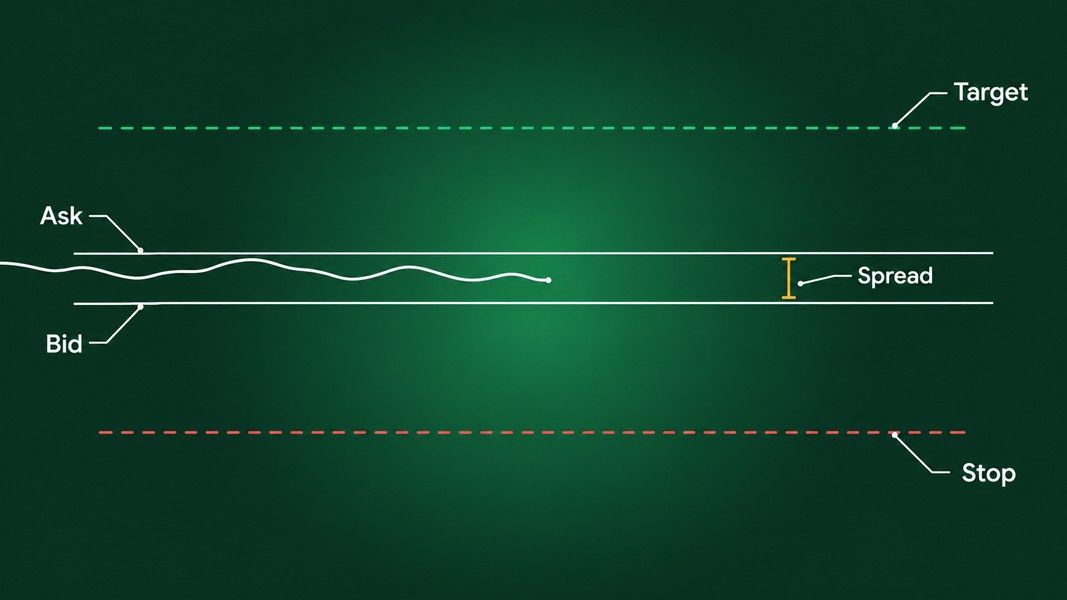
Every stock has two prices at any moment. The bid is the highest price a buyer is offering; the ask is the lowest price a seller will accept. The gap between them is the bid-ask spread.
A market order to buy fills at the ask, and a market order to sell fills at the bid. So the moment you buy, your shares are worth the bid, which is lower than what you paid. You start every scalp behind by the full width of the spread, before the price has moved at all.
For a swing trader aiming for several dollars, a two-cent spread is noise. For a scalper aiming for six cents, it is a third of the target.
A worked example in cents
Say a stock is quoted at $25.00 bid and $25.02 ask, a 2-cent spread. You buy 500 shares at the market and fill at $25.02. Your plan, drawn on the chart, is a 6-cent target and a 4-cent stop.
The quote moves up 6 cents, to $25.06 bid and $25.08 ask. You sell at the market, which means at the bid, $25.06. That is 4 cents a share, $20 on 500 shares, not the $30 the chart promised.
Now the other path. The quote drops 4 cents, to $24.96 bid and $24.98 ask, and you sell at the bid, $24.96. That is 6 cents a share against you, $30 on 500 shares, not $20.
The spread did not change between the two paths. It landed on the wrong side both times.
What the spread does to the odds you need
| On the chart | After the spread | |
|---|---|---|
| Move when the trade works | +6 cents | +4 cents |
| Move when it fails | -4 cents | -6 cents |
| Reward to risk | 1.5 to 1 | 0.67 to 1 |
| Share of trades that must work to break even | 40% | 60% |
A setup that had to work four times in ten on the chart now has to work six times in ten, and that is before any commission or exchange fee. Nothing about the chart changed. The only new thing is that the cost of crossing the spread got counted.
Scalpers try to dodge this by buying at the bid with a limit order instead of paying the ask. That can work, at a price: a limit order may not fill, and the fills you miss tend to be the moves that ran away from you, while the ones that do fill are often the ones about to go against you.
When the Spread Is Widest
The spread is not fixed through the day. Studies of intraday quoting keep finding the same U-shape: spreads widest at the open, narrowing through the session, widening again toward the close. Gerace and Lepone, studying Italian stocks, tie that shape to market makers' inventory costs and to the risk of trading against someone who knows more.
Liquidity matters as much as the clock. Nasdaq's guide to trading for interns notes that spreads tend to be wider for less liquid stocks.
That gives a scalper three questions before a trade, and none of them is about the chart:
- How many cents is the spread right now, against how many cents the target is?
- Is the stock liquid enough that the spread stays near one tick?
- Is it the first minutes after the 9:30 a.m. ET open, when quotes move fastest and spreads run widest?
What Changed for Scalpers in 2026
Two US rule changes matter for a scalper this year, one already in force and one pushed back.
The first is the end of the pattern day trader rule. FINRA's Regulatory Notice 26-10, published April 20, 2026, replaced the day trading margin requirements in their entirety with new intraday margin standards, including the day trade count that marked a customer as a pattern day trader and the $25,000 minimum equity requirement. The change took effect on June 4, 2026, with a phase-in period that ends October 20, 2027, so your broker may still run the old rules until then. For a small account making many round trips a day, the old count was the wall that stopped scalping after four day trades in five business days.
The second is the half-penny tick. In September 2024 the SEC adopted a $0.005 minimum pricing increment for certain stocks priced at $1.00 or more, which would let the tightest spreads quote below one cent. The compliance date had been moved to the first business day of November 2026, and on June 11, 2026 the SEC extended it again, to the first business day of November 2027. Some articles written this year still say half-penny quotes arrive this month. They do not.
What Studies of Very Short-Term Traders Found
No large study isolates scalpers, so the closest evidence comes from day traders as a whole. Two studies stand out because they cover entire markets rather than one broker's customers.
Barber and colleagues examined day trading on the Taiwan Stock Exchange from 1992 to 2006, where day traders accounted for about 17% of all volume and around 450,000 individuals day traded in an average year. Fewer than 1% of all day traders were able to come out ahead of the market after fees in a way that held up predictably from one year to the next. The most active day traders did better than occasional ones, and still could not cover their trading costs.
A Brazilian study by Chague, De-Losso and Giovannetti followed every individual who started day trading mini-Ibovespa index futures between 2013 and 2015. Of the 1,551 who kept at it for more than 300 days, 97% lost money. Only 1.1% took home more than the Brazilian minimum wage, and only 0.5% more than a bank teller's starting salary.
Both studies show the pattern the spread example predicts: whatever edge exists before costs is thin, and the costs are paid on every single trade. These are past samples from two markets, one of them futures rather than stocks, not a forecast of any one trader's results. The direction is hard to ignore, though.
Scalping Trading Strategy: What Scalpers Actually Watch
A scalping trading strategy is mostly a set of filters for when the arithmetic above has a chance. The ones scalpers describe most often:
- Liquid stocks with a spread of one tick, because every extra cent of spread comes straight out of the target.
- The order book and the time and sales feed, to see where size is sitting and whether prints are hitting the bid or lifting the ask.
- Reference levels such as VWAP, the opening range and the prior day's high and low, where many short-term traders act at once.
- A stop decided before the entry, in cents, with the spread already counted in it.
Speed is the part a retail trader cannot buy. The Brazilian authors put it bluntly in one version of their paper: individuals who day trade are competing with high-frequency trading firms. A plan that depends on being first to a one-cent move is a plan built on the other side's home ground.
Where an AI Chart Read Fits, and Where It Does Not
Primo Trade is our own product, so here is the honest version: it is not a scalping tool. It gives an AI analysis of a US-listed stock or ADR from a ticker or from a photo or screenshot of a chart, and it does not stream real-time quotes or show an order book. Its Trading Strategy label is one of Day Trading, Swing Trading, Position Trading, Long-Term Hold or Avoid, and there is no scalping label, which says something about what a read of trend, volume and fundamentals can support.
Where it can help a short-term trader is the bigger picture before a session. Photograph a daily or hourly chart and Primo Trade's AI reads the trend, volatility, volume and sentiment, the chart pattern it sees and what that pattern usually signals. Every result carries a signal, a Primo Score, a Trading Strategy and Key Insights, and a ticker analysis adds recent news. That is context for your own decision, not an entry point.
Primo Trade gives AI-generated analysis for information and education. It is not financial advice. Markets carry risk; do your own research before you trade.
Key Takeaways
Scalping trading means holding a stock for seconds or minutes and aiming for a few cents, many times a day. At that scale the bid-ask spread is not a detail: a 2-cent spread on a 6-cent target turns a setup that needed to work 40% of the time into one that needs 60%, before fees.
Spreads are widest at the open and in thin stocks, which is exactly where fast moves tempt a scalper most. The pattern day trader rule is gone as of June 4, 2026, with brokers allowed until October 20, 2027 to switch, while half-penny quotes are now set for November 2027. The largest studies of day traders, in Taiwan and Brazil, found that only a tiny fraction came out ahead after costs. Count the spread first, and the chart second.