On the evening of May 2, 2024, Apple reported iPhone sales down 10% and total revenue down 4%. By the close the next day, the stock was up 6%, its best session in a year and a half. The line that turned a soft quarter into a rally was a stock buyback: the board authorized up to $110 billion of share repurchases, the largest in US history.
A stock buyback is a company using its own cash to buy its shares back from the market. The shares it buys stop counting, so the same earnings are split across fewer of them. This post reads Apple's record buyback after the fact, over the window from that May 2 report to the record close on June 11, 2024: what the filings showed, what followed, and what nobody could have read off the announcement on the night.
What Is a Stock Buyback?
When a board announces a buyback, it grants permission rather than making a purchase. The authorization sets a ceiling in dollars, and the company then buys over months or years, mostly in the open market through brokers. Apple's annual report for fiscal 2024 says it in one sentence: its repurchase programs "do not obligate the Company to acquire a minimum amount of shares."
That gap between the headline number and the money actually spent is the first thing to hold on to. A $110 billion authorization is a maximum the company may use, on a schedule it chooses.
The rules a buyback runs under
The buying itself follows rules. SEC Rule 10b-18 protects a company from manipulation claims over its repurchases on any day it meets four conditions, on manner, timing, price and volume. Two of them are easy to picture: all of the day's purchases go through one broker, and the company buys no more than 25% of the stock's average daily volume over the previous four weeks.
A buyback is meant to absorb shares quietly over time, not to push the price up in a day. The volume cap is what keeps even a $110 billion program from swamping the market for a stock that trades as heavily as Apple.
Apple's $110 Billion Stock Buyback Announcement
The quarter itself was mixed. In its earnings release for the fiscal second quarter ended March 30, 2024, Apple reported revenue of $90.8 billion, down 4% from a year earlier, and net income of $23.6 billion against $24.2 billion. CNN put iPhone sales at $45.96 billion, slightly under what analysts had projected.
Then came the cash lines. The board authorized up to $110 billion of repurchases, 22% more than the $90 billion authorized a year earlier, and raised the quarterly dividend 4% to $0.25 a share, the twelfth increase in a row. Chief financial officer Luca Maestri framed the buyback around "the value we see in our stock."
The market answered fast. Bloomberg reported the shares up as much as 7.9% after hours, and the next day they closed up 6%, which CNBC called the stock's best day since November 30, 2022.
That 6% did not belong to the buyback alone. The same release carried an earnings figure slightly above estimates and, as Bloomberg reported, a forecast of sales growth for the current quarter. Three pieces of news landed in one evening, and one closing price cannot tell you how much each was worth.
How a Stock Buyback Moves Earnings Per Share
Here is the part of the release that most headlines skipped. Set the March quarter of 2024 beside the same quarter a year earlier, using the figures from Apple's own income statement:
| Fiscal second quarter | 2023 | 2024 | Change |
|---|---|---|---|
| Net income | $24.16 billion | $23.64 billion | down 2.2% |
| Diluted shares | 15.85 billion | 15.46 billion | down 2.4% |
| Diluted EPS | $1.52 | $1.53 | up 1 cent |
Net income fell. Earnings per share rose anyway. The whole of that one-cent rise came from a smaller share count, not from Apple earning more.
Run the arithmetic the other way to see it. Divide the 2024 net income by the 2023 share count and diluted EPS comes out at about $1.49, four cents under the reported $1.53. Fewer shares turned a small fall in earnings into a small rise per share, which is why it pays to know which EPS figure a headline is quoting before you read anything into it.
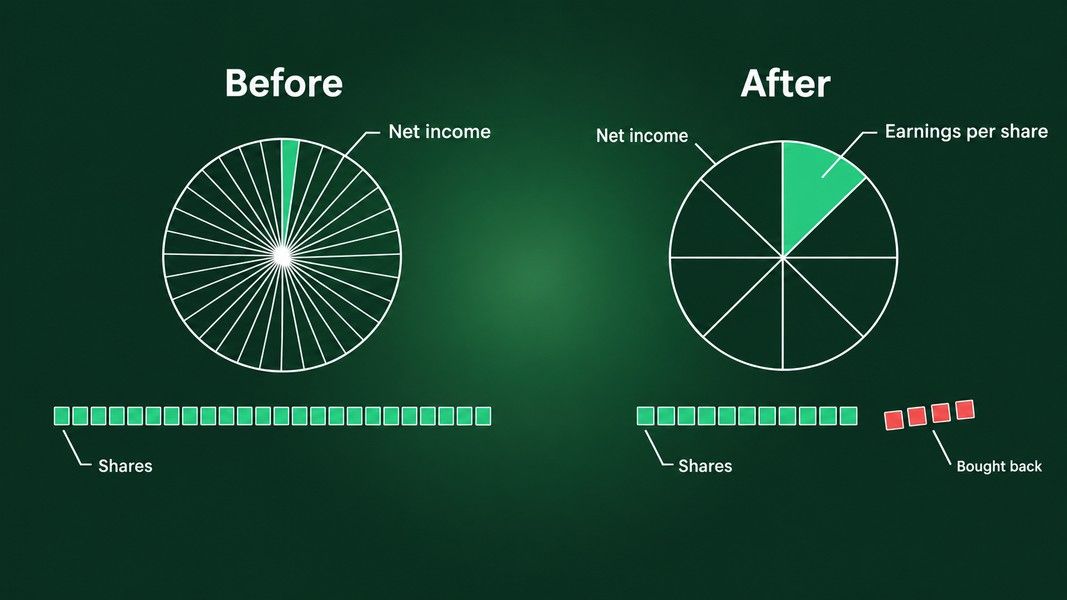
None of this is a trick. Each remaining share really does own a larger slice of the company. It does mean a rising EPS line can hide flat or falling earnings underneath, and a buyback is the most common reason.
Why Do Companies Buy Back Stock?
A company with spare cash has a few things it can do with it: invest, pay down debt, pay a dividend or buy back shares. Apple did all of these in the six months to March 2024. Its cash flow statement shows $62.6 billion generated by operations, $7.5 billion paid in dividends and $43.3 billion spent on repurchases.
A buyback can be slowed or paused at the board's choice, as Apple's own wording shows, while a dividend is expected every quarter until it is cut. According to a Congressional Research Service report, buybacks also get favourable tax treatment compared to dividends.
There is a quieter reason too. Companies issue new shares to employees as pay, and buybacks soak them up. In fiscal 2024 Apple repurchased 499 million shares and issued 66 million to employees, net of shares withheld for taxes, according to its 10-K.
The tax a buyback now pays
Since 2023, publicly traded US corporations pay a 1% excise tax on repurchases, introduced by the Inflation Reduction Act and not deductible against corporate tax, as the same CRS report explains. Treasury's proposed rules apply it to the fair market value of stock repurchased in a year minus the value of stock issued in that year, so new shares reduce the base.
How big buybacks got
Apple is not an outlier in direction, only in size. S&P 500 companies spent a record $942.5 billion on buybacks in 2024, according to the buyback report from S&P Dow Jones Indices. Apple alone spent $104.2 billion in that calendar year and holds 18 of the 20 largest quarterly buyback totals in the index's history.
What Happened After the Announcement
The stock kept climbing into June, but not on buyback news. On June 10 Apple showed its AI software at its developer conference, and on June 11 the shares closed up 7% at a record $207.15, according to CNBC, beating the previous record from December.
The buying, meanwhile, went on in the background. Apple's quarterly report shows 387 million shares repurchased for $70.0 billion in the nine months to June 29, 2024. By the end of the fiscal year in September the total was 499 million shares for $95.0 billion, an average of about $190 a share. Shares outstanding fell from 15.55 billion to 15.12 billion over the year, a drop of 2.8%.
The record close in the window came from a product announcement, not from the $110 billion. Two jumps stand out in those six weeks, May 3 and June 11, and only the first had anything to do with repurchases.
What the Announcement Could Not Tell You
Reading the May 2 release after the fact makes its limits easy to see. On the night, four questions had no answer in it:
- Whether the money would be spent, or when. The authorization was a ceiling with no obligation and no deadline.
- What price Apple would pay. The average turned out near $190 a share, and a higher price means each dollar retires fewer shares.
- Which part of the 6% belonged to the buyback. An earnings beat, a sales forecast and the buyback arrived together.
- Whether earnings would grow. The one-cent EPS rise in that quarter came from fewer shares, not more income.
The last one matters most for anyone reading a chart and a headline together. A buyback can lift EPS for years while the business underneath stands still, and the EPS line alone will not say which is happening.
Reading a Stock Buyback in Your Own Research
You do not need a model to check a buyback; the earnings release holds what you need. Compare the diluted share count with the same quarter a year earlier, set net income growth beside EPS growth, and look at where the cash came from. If repurchases run ahead of free cash flow for long, the money is coming from the balance sheet instead.
Primo Trade's ticker search pulls prices, recent news and financial metrics for a US-listed stock and runs one AI analysis over them, so a buyback headline in the recent news sits beside the numbers instead of on its own. Its Key Insights are each tagged technical, fundamental, news or sentiment, which shows you whether the AI's read leans on the headline or on the financial metrics.
Primo Trade gives AI-generated analysis for information and education. It is not financial advice. Markets carry risk; do your own research before you trade.
The Takeaway
A stock buyback is a company buying its own shares, and an announcement is permission to do it, not a purchase. Apple's $110 billion authorization in May 2024 came with a 6% day, but the same evening also carried an earnings beat and a sales forecast, so the price cannot be pinned on the buyback alone.
The filings tell the clearer story. In the March quarter, net income fell 2.2% while diluted EPS rose a cent, because the share count fell 2.4%. Over fiscal 2024 Apple bought 499 million shares at an average near $190, and its record high in June followed a software announcement. Read a buyback through the share count and net income side by side, and the headline number becomes the least informative part of it.