On January 4, 2024, Walgreens Boots Alliance shareholders woke up to a smaller check. The pharmacy chain cut its quarterly dividend from 48 cents to 25 cents a share, and the stock fell 11% that day. A few weeks earlier the same stock had looked like a bargain to income hunters, because its dividend yield sat near 9%.
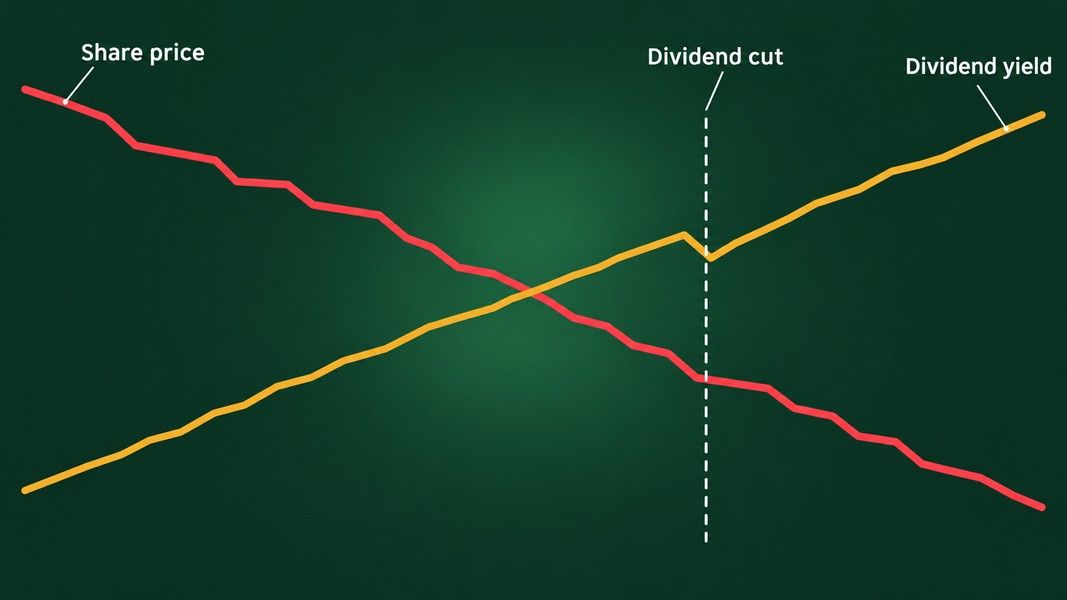
So what is dividend yield? It is the cash a company pays you in dividends over a year, divided by the price of one share, written as a percentage. A yield is a ratio, so it rises when the dividend grows and also when the share price falls. Walgreens, read after the fact from its filings and the coverage at the time, shows how the second kind of rise can look exactly like the first.
What Is Dividend Yield, in One Line of Math
The formula fits on a sticky note: annual dividends per share divided by the current share price. Fidelity's own worked example uses a company paying $1 a year with shares at $25, which gives a yield of 4%.
There are two common ways to fill in the "annual dividends" part. Trailing yield adds up what the company actually paid over the past 12 months. Forward yield takes the most recent quarterly payment and multiplies it by four, which assumes the next year looks like the last quarter. As the Fidelity guide shows with its own numbers, the two can differ slightly, 3.04% against 3.08% in that case.
The difference stops being slight when a dividend changes. Right after a cut, the trailing figure still includes the old, bigger payments, so it overstates what you would actually receive. Data providers do not all follow one convention either, so two sites can show two yields for the same stock on the same day.
Why Walgreens' Dividend Yield Climbed Toward 9%
Walgreens paid 48 cents a quarter through 2023, $1.92 for the year, according to its fiscal 2024 annual report. The dividend did not grow that year. The price did the work.
Morningstar's account of the case notes that the share price fell 25% in 2023, after dropping further than the broad market in 2022. Pharmacy reimbursement pressure, tough conditions for physical stores and acquisitions that had not paid off all weighed on the business. With the dividend frozen and the price falling, the yield drifted up to around 9% by the end of 2023.
A yield near 9% on $1.92 a year implies a share price of roughly $21. Compare that with where the market as a whole sat: S&P Dow Jones Indices data cited by First Trust put the S&P 500 index yield at 1.46% in late January 2024, and the consumer staples sector at 2.68%.
The streak that made it look sturdy
The yield was not the only thing pulling buyers in. Walgreens and its predecessor, Walgreen Co., had paid a dividend in 365 straight quarters, 91 years, by the company's own count. Some investors called it a dividend aristocrat. A record that long feels like a promise, and it is not one.
The Cut: January 4, 2024
The company's announcement was short. The board declared 25 cents a share, "a reduction of 48 percent from the previous quarter," payable in March. Chief executive Tim Wentworth said the aim was "to strengthen our long-term balance sheet and cash position."
The same release said the company was "maintaining a competitive yield." That phrase is worth sitting with. A 25 cent quarterly payment is $1.00 a year, down from $1.92, and at the lower post-cut share price that still looked generous on a yield screen.
Reuters reported that the shares fell 11% on the news. Holders lost close to half their income and a tenth of their capital on one morning, which is the double hit a dividend cut usually brings.
Why the Yield Got Even Higher After the Cut
Here is the part that trips people up. Cutting the dividend did not bring Walgreens' yield down for long, because the price kept falling. Morningstar puts the decline for 2024 at 60%.
On December 9, 2024, the day before media first reported a possible buyout, Walgreens closed at $8.85, a figure taken from the company's later merger announcement. Divide the new $1.00 annual dividend by $8.85 and the forward yield comes out at 11.3%. The stock looked more generous after cutting its dividend than before it, and the business was weaker, not stronger.
The suspension and the exit
On January 30, 2025, the board suspended the dividend entirely. Reuters reported the shares down nearly 8% in extended trading, and the Associated Press noted that the move broke a streak of more than 90 years. The quarterly filing for the period ending May 31, 2025 shows the result in cash: $432 million paid to shareholders in those nine months, against $1.0 billion a year earlier.
In March 2025, Walgreens agreed to be bought by private equity firm Sycamore Partners for $11.45 a share in cash, plus a right to as much as $3.00 more from the future sale of its VillageMD businesses. The deal closed on August 28, 2025, and the stock stopped trading on Nasdaq. The case is closed, which is why it can be read here as history and nothing else.
What the High Dividend Yield Was Really Telling You
A yield tells you what the dividend is worth against today's price. It says nothing about whether the company can afford to keep paying it. For that you need numbers from further down the financial statements.
The clearest one in Walgreens' case is the payout ratio, the share of earnings handed out as dividends. According to Morningstar's analysis, Walgreens' payout ratio at the end of 2023 was 290.91%. The company was paying out nearly three times its earnings, while its free cash flow was negative.
Set beside the broad market, the gap is plain. The S&P 500's payout ratio stood at 36.89% on December 29, 2023, according to a First Trust note using S&P Dow Jones Indices and Bloomberg data.
| Measure, end of 2023 to January 2024 | Walgreens | Consumer staples | S&P 500 |
|---|---|---|---|
| Dividend yield | about 9% | 2.68% | 1.46% |
| Payout ratio | 290.91% | not given | 36.89% |
Morningstar's own research adds a pattern from the past 20 years: companies with high payout ratios were the most likely to cut their dividends, and companies without a durable competitive edge cut more often than those with one. Walgreens had a high payout ratio and, in Morningstar's view, no such edge.
When earnings and cash disagree
A payout ratio built on earnings can flatter or punish a company, because accounting charges move earnings without moving cash. That is why checking free cash flow beside it matters; our post on the free cash flow formula walks through why the two numbers part ways.
How to Read a High Dividend Yield Before You Trust It
None of these checks predicts a cut. They tell you whether the yield is backed by something or held up by a falling price.
- Ask why the yield is high. If the dividend rose, that is one story. If the price fell 25% in a year, find out why before reading the yield as a bargain.
- Compare the yield with its sector and the index. Walgreens yielded more than three times the staples average, an outlier that needed an explanation.
- Check the payout ratio and free cash flow. Dividends paid out of shrinking or negative cash have to come from debt, asset sales or a cut.
- Read what management says about the dividend. Walgreens explained both its cut and its suspension in terms of capital allocation and the balance sheet.
- Use forward yield after any change. The trailing number keeps counting payments that no longer exist.
A low share price on its own is not the warning. The price-to-book story told in our post on how Intel fell below book value follows the same logic: a ratio that looks cheap can be cheap for a reason.
A second read on the fundamentals
If you want a quick second opinion on a US-listed dividend payer, Primo Trade's ticker analysis pulls prices, recent news and financial metrics into one AI read. The result includes a Primo Score with a Fundamental axis from 0 to 100 and up to three Key Insights, each tagged as technical, fundamental, news or sentiment. Primo Trade gives AI-generated analysis for information and education. It is not financial advice. Markets carry risk; do your own research before you trade.
Treat that score as one more input next to the payout ratio and the filings, not a substitute for them. A Fundamental score of 30 is a summary of the data the AI saw on that day, not a probability that a dividend will be cut.
What a Reading at the Time Could Not Know
Hindsight makes the Walgreens story look obvious, so it is worth being fair to anyone who bought at a 9% yield in late 2023.
The payout ratio, the falling price and the negative free cash flow were all visible. What nobody outside the boardroom could see was the timing: whether the board would cut in January 2024 or hold on another year, and whether it would go further and suspend the dividend a year later. Nor could anyone know that a buyout at $11.45 in cash would end the public story in August 2025.
The numbers could tell you the yield was fragile, not when it would break. That is the honest limit of reading a dividend from the outside, whether you do it by hand, with a spreadsheet or with Primo Trade.
The Takeaway on Dividend Yield
Dividend yield is annual dividends per share divided by the share price, a simple ratio that moves with both parts. When it climbs because the price is falling, the high number can be a warning rather than a gift.
Walgreens paid $1.92 a year in 2023 and yielded about 9% as its shares slid. It cut to $1.00 in January 2024, yielded 11.3% at the $8.85 price of December 2024, suspended the dividend in January 2025 and left the market in August 2025. Its payout ratio near 291% at the end of 2023, against 36.89% for the S&P 500, said more about the dividend's future than the yield did.
Read a high yield next to the payout ratio, free cash flow, the sector average and the reason the price fell. Even then, the numbers show fragility, not a date.